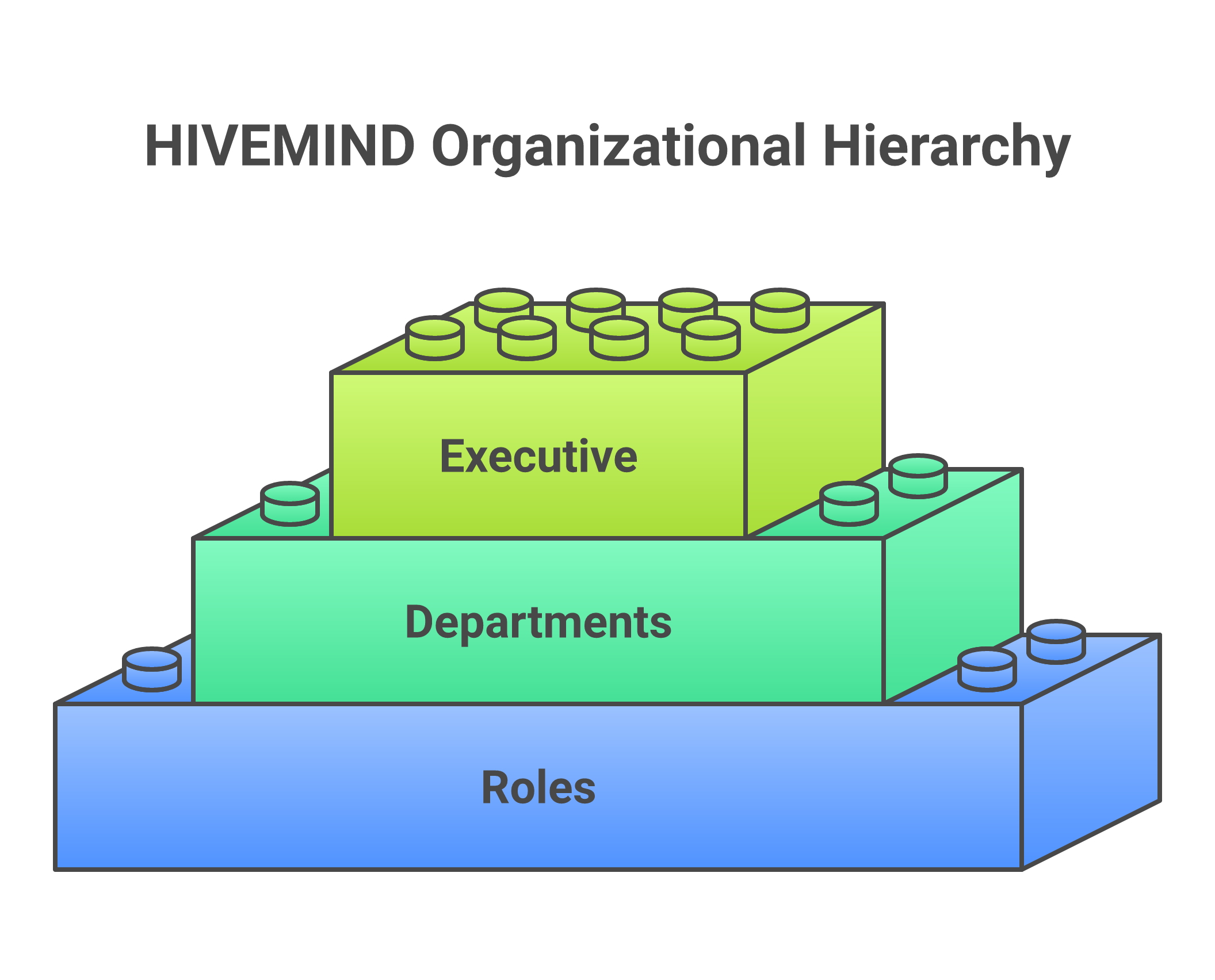
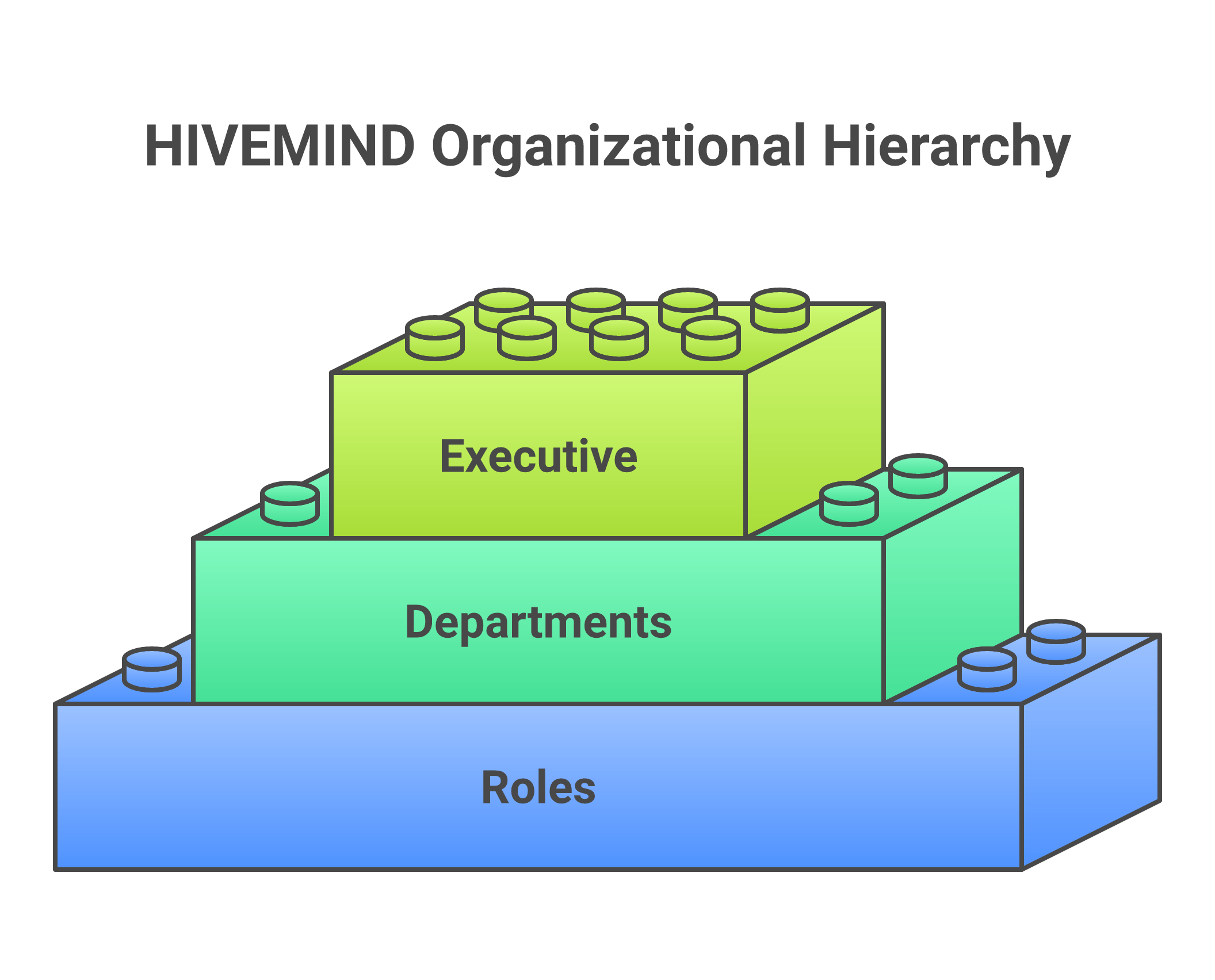
The most expensive failure in a mid-sized company isn’t a data breach — it’s a resignation. When a senior salesperson leaves after seven years, the relationship history and undocumented know-how walk out the door with them. HIVEMIND answers with role-bound agents: one shared AI agent per job function that outlives the people who use it — so institutional knowledge stays, offboarding becomes a one-line edit, and security is the enabling constraint, not the headline. Part of our open Building Jarvis series.
Abstract
HIVEMIND is a multi-agent AI architecture for corporate deployment whose central commitment is organizational continuity: the institutional knowledge lives in the agents, and the agents outlive the humans who use them. The key move is role-bound agents — one canonical agent per job function (a single sales rep agent, a single field engineer agent), shared by every human who holds that role, rather than a personalized agent per individual.
This makes talent retention a non-issue (the agent never resigns), collapses cross-department coordination to one channel per function, and reduces onboarding to a single sentence: the new hire tells the agent which territory they now own. Knowledge enters through a knowledge cascade — a version-controlled vault of company canon, industry context, the customer model, and product knowledge — maintained by former trainers reborn as knowledge stewards who train the AI once instead of each hire repeatedly.
Security is retained as the enabling constraint: a five-tier classification model mapped to Linux filesystem permissions and grounded in Bell-LaPadula, applied at role granularity, with a controlled declassification pipeline, a fresh-context “doubt reviewer” that tests for implication-leakage, nightly compliance sweeps, and GDPR / EU AI Act analysis. We frame HIVEMIND as an architectural design paper, and present the same agent network read along six orthogonal axes — clearance, supervision, bottleneck reduction, workload sharing, self-modification, and knowledge propagation.
The design, in numbers
Claims from the paper, stated here without the proofs — they’re in the PDF.
How it works, in one minute
- The agent is bound to the role, not the person. One
sales repagent serves every salesperson; when someone leaves, nothing is snapshotted or scrubbed — the agent keeps serving the next occupant, and offboarding is a one-line edit to a workload map. The talent leak is removed at the source. - Knowledge cascades. Company canon → role slice → workload map → a thin per-person layer, mounted from a shared Markdown vault via symlinks (which can’t escalate clearance — the kernel checks the target). Update the vault once and every agent in the role has it instantly.
- Coordination mostly dissolves. Because one shared agent holds the whole team’s history, “assemble the customer history” is trivial and ownership is resolved contextually — the agent knows who it’s serving and defers on another rep’s account. No cross-agent email routing.
- One network, six axes. The same org chart of agents carries clearance (downward only), supervision (managers inspect memory), knowledge propagation, dynamic workload sharing, bottleneck reduction, and self-modification — each a differently-colored path, each in tension with the others.
- The workforce upgrades itself — safely. Only IT may rebuild the gateway; users file richly-detailed tickets that IT’s own agent ingests, vibe-codes, tests, and rolls out to the shared agent for everyone at once. Clearance still lives below the model, enforced by the Linux kernel, not a prompt.
Built in the open. HIVEMIND runs on TinkerClaw, our fork of OpenClaw — the multi-agent substrate behind this whole series.
Read the paper

49 pages · role-bound agents, the knowledge cascade, the six-axis network, the Sales Coordination case study, the doubt-reviewer leakage oracle, and the full compliance + risk model
Was this useful?
We’re building these in the open and we want your read on them. Did this land — 👍 or 👎? What would you want the next paper to dig into? Tell us in the comments below.
More from Building Jarvis
- SEAHORSE: What Actually Makes an Agent Code Well
- MAESTRO: What Orchestration Actually Buys — A Taxonomy of Latency, Capability and Supply
- STRIATUM: Learned Personality Modulation — Tuning an Agent’s Behaviour from Feedback, Not Static Prompt Text
- BROCA: Giving Agent Recipes a Grammar — A Gradual Type System and Combinator Algebra for Self-Composing Workflows