Your agent is making decisions from a frozen list — a hardcoded model rank, a round-number budget cap, a pinned prompt written for last year’s model. The world moved; the list didn’t. SALIENCE argues that relevance must be re-computed from the live situation at the moment of use — never read off a frozen artifact. Part of our open Building Jarvis series.
Abstract
The salience network in the human brain does not fire on a fixed rule. It continuously re-computes, moment to moment, what is relevant right now — and switches the rest of cognition between its default and executive modes accordingly. We take that as the design thesis of this paper: relevance must be re-computed from the live situation, not read off a frozen list.
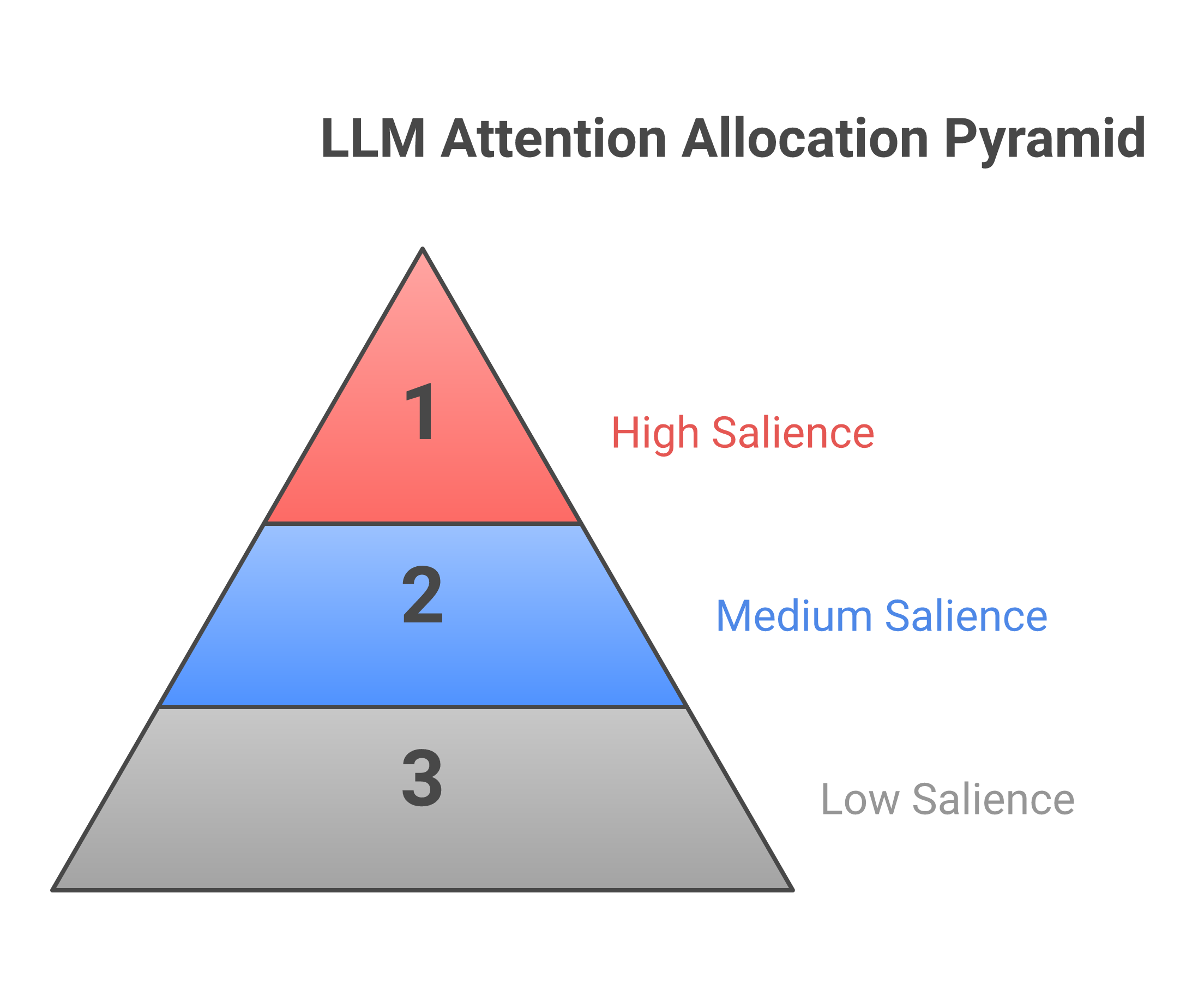
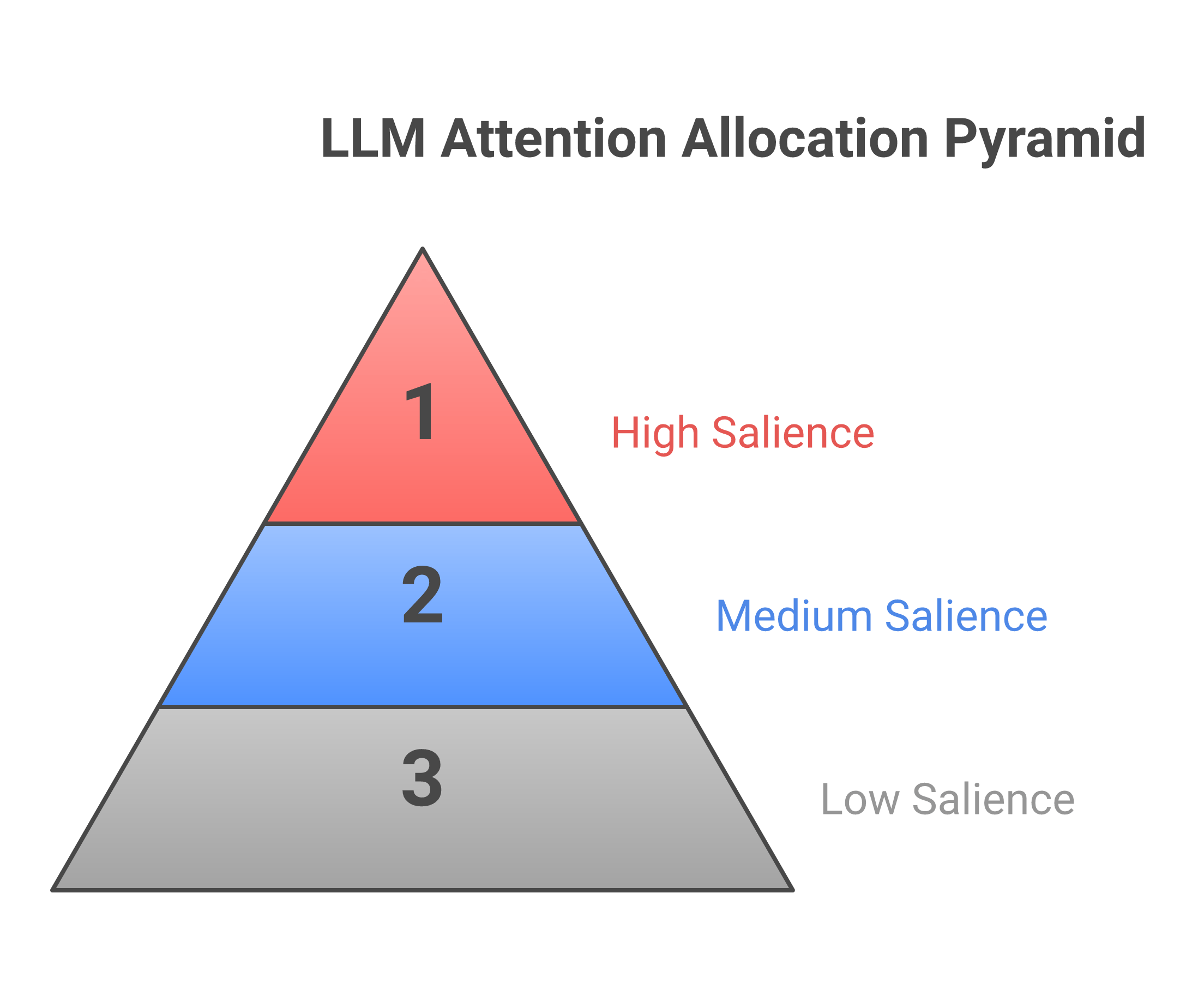
This paper makes three connected arguments about how a capability-first agent harness should be built. First, the death of fixed thresholds and fixed lists — hardcoded numbers, frozen rankings, and round-number caps are legacy artifacts of the primitive programming era; the successor is salience: derive every decision from the live situation at the moment of use. Second, the pyramid of significance — knowledge and code organised as a fractal pyramid ordered by significance: base principles at the apex, then structural optics, then derived rules, then diagrams and flows, then code — each level deriving from the one above and forbidden to contradict it. Third, cheap code-traversal as the basis of next-generation vibe programming — attacking both the reach cost of getting to knowledge and the carry cost of holding it.
We describe the executable embodiment of all three: a native orchestration runtime (agent/parallel/pipeline/phase) with concurrency and budget derived from the live situation — planned, with its derived-bound substrate now partly live. The honesty is the point: a paper that overstates its system is the documentation equivalent of an agent that declares victory before it verifies.
The claims, in numbers
Claims from the paper, stated here without the proofs — they’re in the PDF.
Three pillars, one principle
- Kill the fixed threshold. A hardcoded constant encodes yesterday’s judgment about a world that has since moved. The salience replacement: derive every quantity bound from the live situation at the moment of use, keep the frozen number only as a safety ceiling, and emit adaptive pressure as the agent approaches it — cliff becomes ladder, not guillotine.
- Order by significance. Tear out every threshold and you get a system whose behavior is a function of everything — which is more correct and much harder to reason about. The pyramid anchors it: a small, stable apex of base principles pins the invariants; the churning base inherits them. Each level derives from the one above and may not contradict it. A contradiction is a typed bug, not a choice.
- Make traversal cheap. Live computation requires reading the live situation, and if reading is expensive the discipline collapses back into caching stale answers — which is a fixed list with extra steps. Six instruments attack the cost: a pre-compressed optics map, a knowledge graph, deferred-tool loading, paired read surfaces, an intent router, and reversible carry-time compression.
- It’s a single principle, not three topics. Compute relevance live (Pillar 1). Order it by significance so “everything is live” doesn’t mean “anything goes” (Pillar 2). Make it cheap enough to actually do (Pillar 3). The orchestration runtime in §5 is where all three meet in running code.
- Honesty as methodology. The four orchestration primitives are specified and not yet native. The derived-bound substrate beneath them is live at real seams. The paper draws that line precisely — because a fixed claim against a moving implementation is exactly the stale-artifact anti-pattern Pillar 1 condemns.
Where this fits in the open-source agent stack
Two open-source projects released in 2025–2026 provide direct external evidence for this paper’s claims — and, in one case, honestly expose a gap in it. The paper positions both as first-class related work, not footnotes.
chopratejas/headroom ~24.7k ★
A reversible Compress-Cache-Retrieve (CCR) layer — compress active context by content type (JSON, code, logs, diffs), cache originals, retrieve on demand. Reports 60–95% token savings at near-zero accuracy delta, with a reproducible eval suite and proxy/MCP/library form factors.
Relationship to this paper: headroom occupies the carry-cost half of the comprehension tax this paper’s five original instruments leave untouched. Those five reduce reach cost — get to the right file, state, or tool fast. Reversible CCR reduces carry cost — shrink what you already pulled. Pre-compression at source and reversible compression at carry-time are complementary, not competing. headroom also exposes the measurement gap this paper concedes: it ships numbers; Pillar 3 ships none.
addyosmani/agent-skills ~56.8k ★
Engineering-discipline skills, subagent personas, and command definitions for coding agents. Roughly 70% overlaps this project’s own discipline stack — validating rather than novel for the most part.
Relationship to this paper: Two authoring conventions are genuinely worth adopting and sharpen Pillar 2’s authoring side: an explicit “When NOT to use” section per skill and a “Loading Constraints” section declaring where a skill may load. Both are significance-ordering applied to authoring a unit — they pin, at the apex of each skill, the conditions under which the unit is relevant. That is the Pillar-1 “compute relevance, don’t assume it” discipline pushed up into documentation.
The SALIENCE pyramid, the derived-bound substrate, and the orchestration runtime are part of Building Jarvis, an open series on next-generation agent harness design. Follow the work and contribute at github.com/globalcaos/tinkerclaw.
Read the paper
The three pillars in full — the fixed-artifact typology, the whole-system audit, the pyramid governance, cheap-traversal instruments, the orchestration runtime status, and the honest boundary
Was this useful?
We’re building these in the open and we want your read on them. Did this land — 👍 or 👎? What would you want the next paper to dig into? Tell us in the comments below.
More from Building Jarvis
- Instant Recall: A Pre-Computed Concept Index for O(1) Memory Retrieval in Persistent AI Agents
- Fractal Reasoning: Multi-Resolution Memory and Self-Similar Metacognition for LLM Agents
- Identity Persistence: Keeping an LLM Agent’s Personality Stable Across Sessions, Model Swaps, and Restarts
- Sleep Consolidation: How Nightly Prompting Makes a Stateless Agent Get Better Over Time