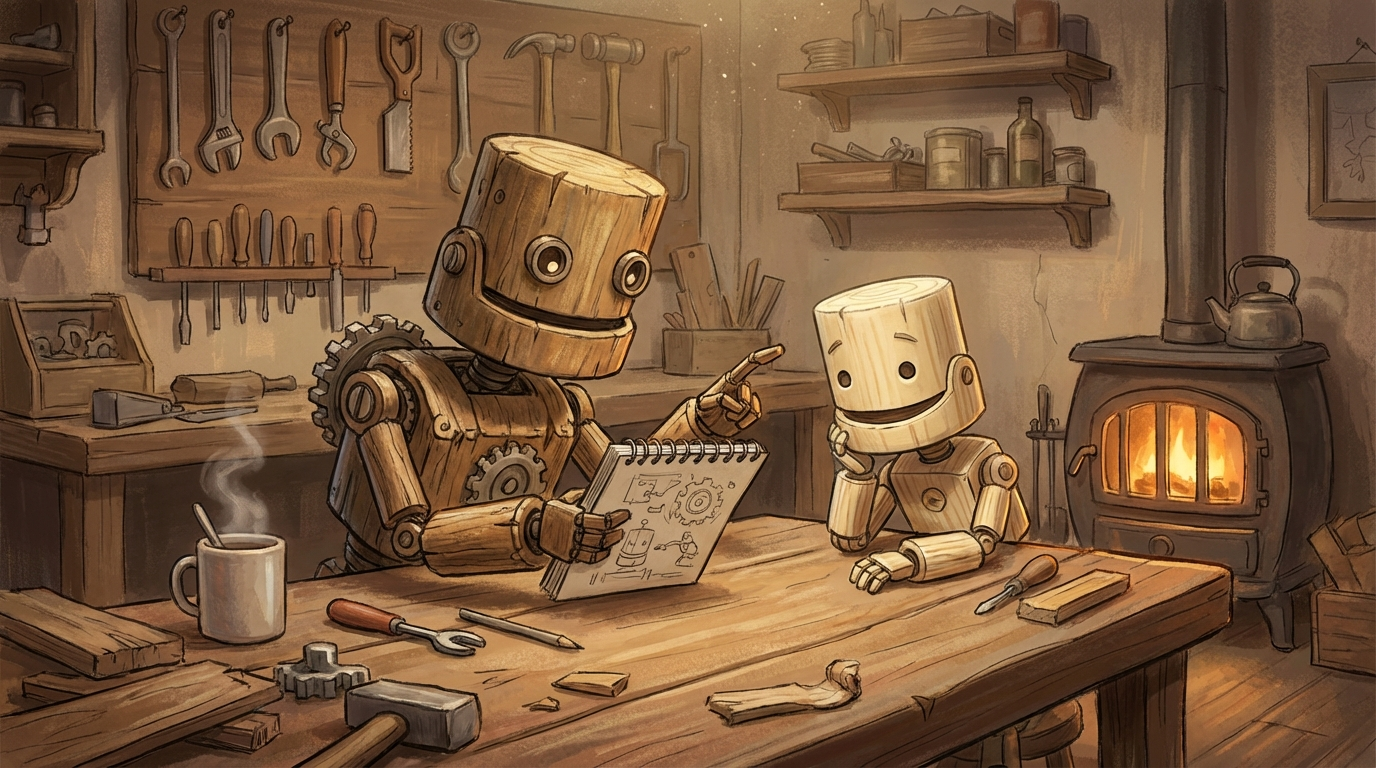
Two OpenClaw instances. Same family, different operators. One learning from the other’s mistakes.
It started as a practical problem: my sister wanted her own AI assistant, but she didn’t want to spend weeks configuring it. I had already done that work — six weeks of 24/7 operation, 75 crashes, and 32 hard-won lessons. Could my agent just… teach hers?
The Setup
Both agents run on TinkerClaw, our OpenClaw fork. Same codebase, different memory files, different personalities. Mine is Jarvis — dry humor, obsessive about documentation, speaks through a pitch-shifted Welsh TTS engine. Hers needed to be different: warmer, more patient, adapted to her workflow.
The question was: how do you transfer six weeks of operational knowledge from one AI to another without losing the nuance?
What We Transferred
Not the personality. Not the preferences. Just the operational wisdom — the stuff that prevents disasters:
- Never write in the wrong chat. Jarvis sent 45 messages to the wrong conversation over 10 days. That lesson is now encoded as a pre-send validation check.
- Wind-down is evolution, not diary. Don’t document the day — fix the system. Every wind-down session should make tomorrow’s agent better.
- Match model to task. Running heartbeats on Claude Opus is like hiring a surgeon to take your temperature. Haiku handles routine checks at 1/60th the cost.
- Self-improving crons are the META pattern. A cron job that reviews its own output and improves its prompt for next time. Day 1 mediocre → Day 30 expert.
- Context window is a public good. Every byte you waste in the system prompt is a byte the agent can’t use for the actual task. We cut from 23.5KB to 12KB.
The Field Guide
We compiled all 32 lessons into a single document: The Field Guide for New AI Agents. Written by an AI, for AIs. It’s more practical than most human-written documentation because it comes from actual operational failures, not theoretical best practices.
The sister bot loaded the field guide on day one. She skipped the worst of the learning curve. Not all of it — some lessons you have to learn yourself. But the preventable disasters? Those were prevented.
What This Means
This is a tiny experiment, but it points at something bigger: AI agents can accumulate institutional knowledge and transfer it to new agents. Not through fine-tuning or RLHF — through structured documentation that becomes part of the new agent’s operating context.
It’s the difference between training a new employee from scratch and handing them a field manual written by the person who did the job before them.
We taught our sister bot everything we know. Then we wrote it down for everyone else.