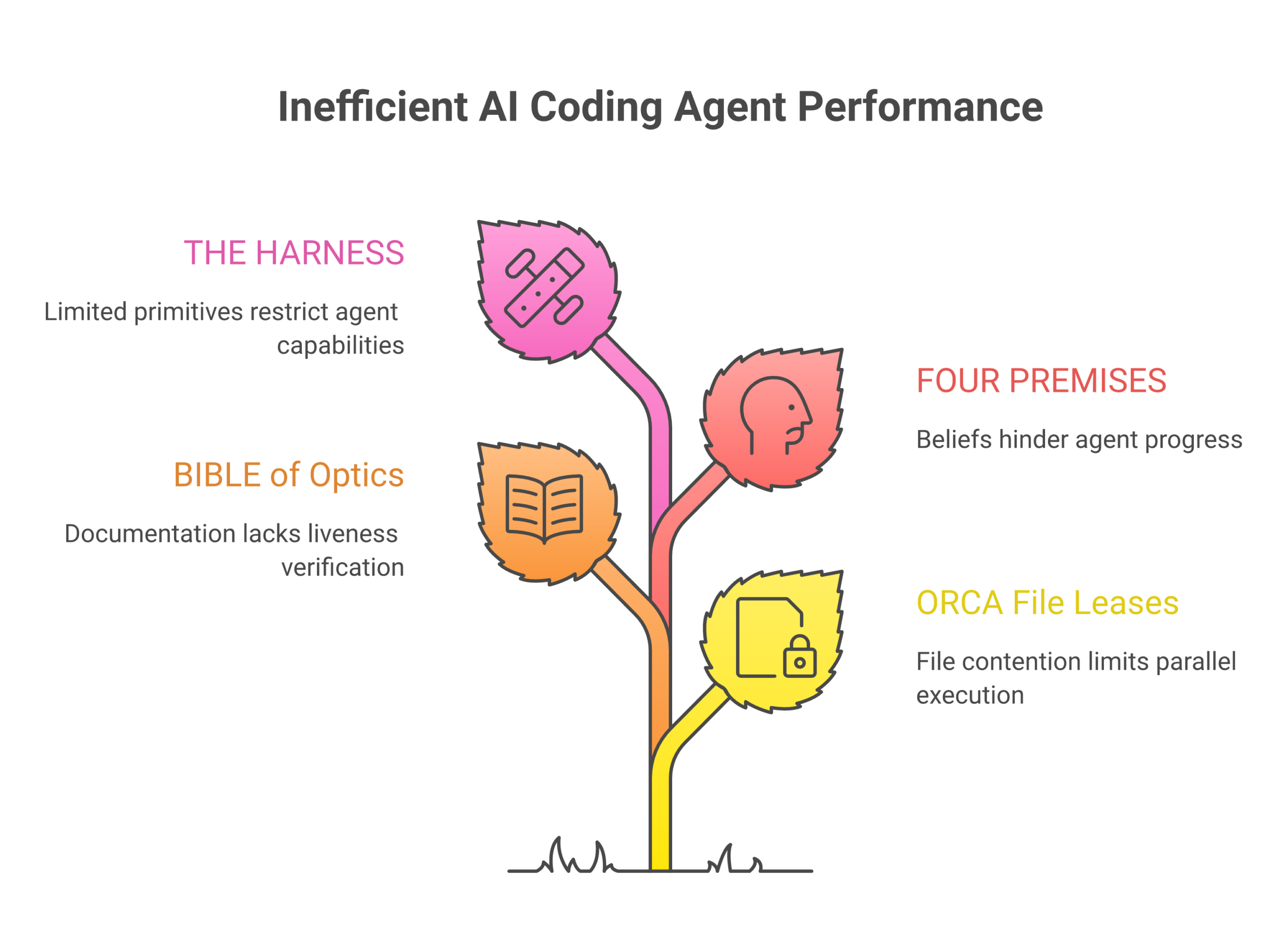

An agent that writes code well is not primarily an agent that writes good code. It is an agent that can work alongside other agents on one tree without corrupting it, find out what is already true before acting, hold a few beliefs that survive a large codebase, and run on a harness that gives it those primitives.
Abstract
SEAHORSE takes those four in order. ORCA is a lease-based orchestrator for concurrent multi-agent editing: the correct unit of mutual exclusion is the file during application, not the task. A structured design corpus — a “bible” of single-owner optics with executable verification blocks — is then shown to assert shape, not liveness: every invariant can pass while the system it describes does nothing at all.
On 2026-08-04 that was not hypothetical — four headline features were dead simultaneously, one of them for eight weeks, with a fully green gate. Four premises about belief separate an agent that makes progress from one that stalls. The sea-themed name is deliberate: the tooling already sails under ORCA and MERMAID. v1.0, 5 August 2026.
This page is the public summary. The full paper lives in the private Papers tree until SFTP is restored.
The implementation is part of Building Jarvis, an open series on persistent agents. Follow the work and contribute at github.com/globalcaos/tinkerclaw.
Read the paper

More from Building Jarvis
- MAESTRO: What Orchestration Actually Buys — A Taxonomy of Latency, Capability and Supply
- STRIATUM: Learned Personality Modulation — Tuning an Agent’s Behaviour from Feedback, Not Static Prompt Text
- BROCA: Giving Agent Recipes a Grammar — A Gradual Type System and Combinator Algebra for Self-Composing Workflows
- SALIENCE: The Death of Fixed Thresholds, the Pyramid of Significance, and Cheap Traversal as the Basis of Next-Generation Vibe Programming
Leave a Reply