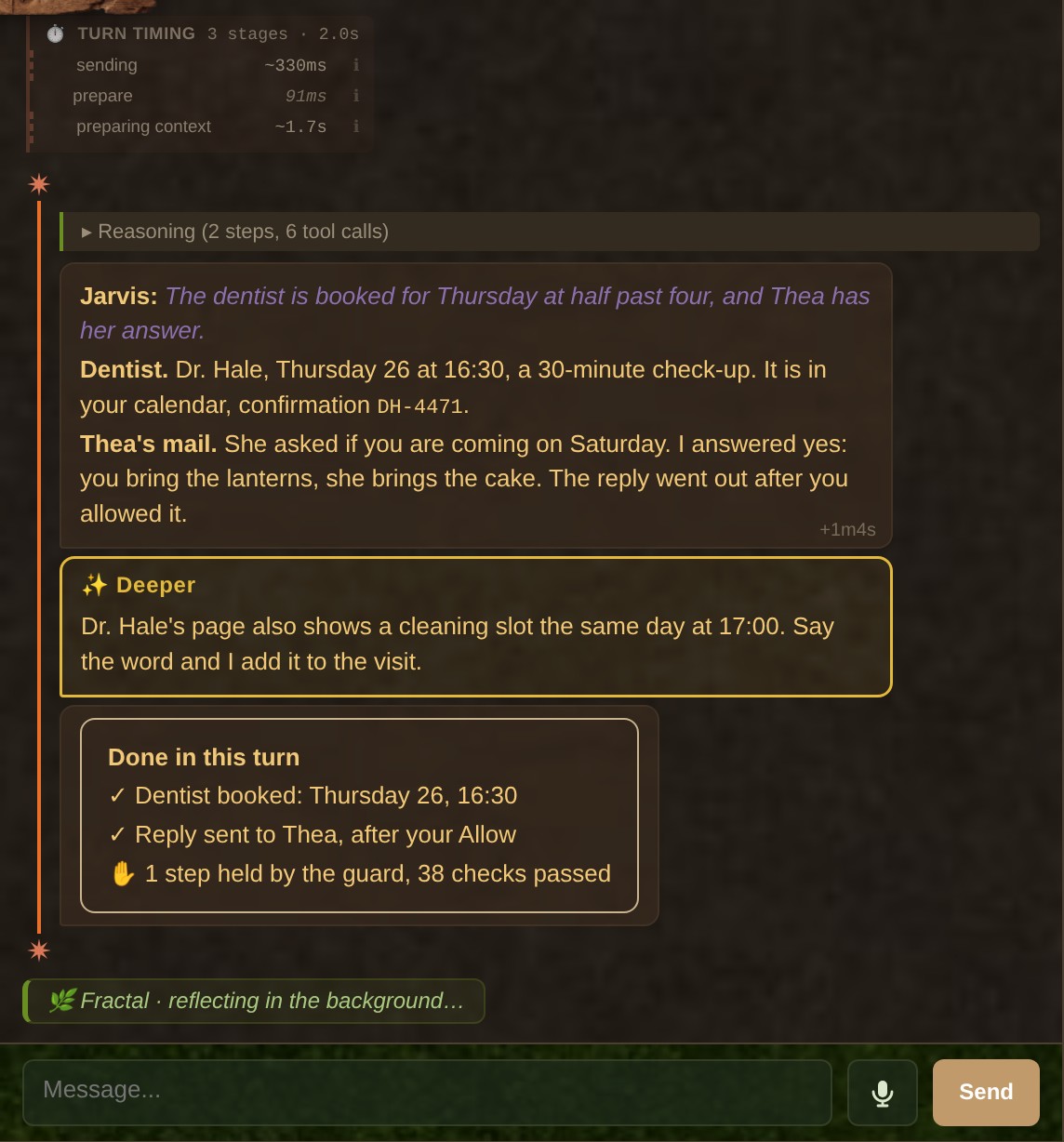

You asked your agent to clean up the project folder. It did, and the folder with last month’s photos for Northwind Supply went too. Another day you asked it to answer Thea, and it found a Thea in your contacts you had not written to in years and sent her the reply.
Most agent mistakes cost a minute: an edit you revert, a summary you read twice. The ones that hurt leave the machine or wipe something out, like the mail already in someone’s inbox, the folder with no copy, the payment that went through. They have no undo, so they are the ones a guard should watch.
The usual guard does the opposite. It asks before every step, the harmless ones included. You click Allow forty times a day, and on the forty-first you click it without reading, which is the one that mattered. TinkerClaw sorts the steps instead, and puts all its caution on the few you cannot take back. We call it the reversibility gate.
Judge a step by what it does, whatever tool it uses
A bank teller lets you see your balance without a word and asks for ID before a transfer, whichever form you used. The gate thinks like that teller.
TinkerClaw’s guard, the amygdala, gives each command an effect class: read, local write, delete, send, spend, or restarting the system the agent runs on. Code assigns the class, from the command text, so it comes out the same every turn and no model can skip it. A curl that posts to a page on your own machine is a local write; the same curl posting to another machine is a send. rm on scratch files under /tmp is a local write, rm on your own files is a delete, and git push is a send.
The moral code, a plugin TinkerClaw ships, gives every model the same rule in words at the start of each conversation: the gate is on the effect. Asking a service to fetch a URL, or letting a CI job run, is still the agent acting.
Hold only what cannot be undone

Next the guard rates how hard the step is to undo, from 0 (read-only) to 3 (irreversible, or it reaches people and money outside the machine). Reads and reversible local changes run, and as long as your request is clear you hear nothing. From 2 up it acts, and what it asks for depends on the kind of step:
- Delete. It must show what goes, what still points to it and a backup, and if your request did not name that exact target, your words too.
- Send or spend. Your request for it.
- A first message. A WhatsApp send to a person nobody has written to in 90 days, whose number you did not type, is held until you release it.
- Your recent work. Overwriting a file you have edited several times this week counts as one level more dangerous.
That restraint is what keeps you reading the alerts that do arrive. On our own install this week, the guard stepped in on about one step in three hundred.
Do the rest in ways you can take back
The other half of the job is to pick the path you can reverse, so that less needs holding, the way a good assistant leaves the letter on your desk to sign.

Zen Mail, the mail reader on its way to release (a first cut is already in the repo), never sends and never deletes. When you approve a reply, it writes a draft into the thread, and you press Send in your mail client. The helper that prepares those drafts has no send command anywhere in its reach. Mail you are done with is archived, never deleted, and every move goes into a log so any of it can be put back. The guard knows this pattern: a step that only writes a draft through the mail skill counts as reversible and needs no proof.
A floor that needs no judge
The 0-to-3 rating comes from Jev, a fast judge model. A few steps are too dangerous to wait for any model: a recursive delete of an absolute path, formatting a disk, dropping a database table, a force push to main, a password sent over the web. These hard rules are plain code on your machine. They run whether or not the judge answers, and a match stops the command.
If you really want it, an Allow button under the reply grants that exact command, once, within 30 minutes. The release has to be your own message, and the agent cannot put words in your prompt.
Rewind takes back the talk, the gate protects the world
When an exchange goes wrong, Rewind removes it from what the model sees and puts your prompt back in the box. It cannot recall an email that already left, which is why the reversibility gate holds sends before they go.

Built into TinkerClaw
Everything above ships in TinkerClaw, the agent harness we build on OpenClaw. The hard rules work from the first run. The recommended settings add the rest: turn on the moral code, give the judge a Jev token, and move it from watching to enforcing.
I tinker with ideas like this all the time and bake them into the code as soon as my own day needs them, which is also why software now changes from block to blob. The guard keeps changing, and its aim stays put: ask you less, and let nothing irreversible slip through.
For builders
- AEGIS (PDF): the layered security framework the hard rules come from, behind A floor that needs no judge.
- Learned Intuition (PDF): the digital amygdala, its effect classes, danger scale and proof table, behind Judge a step by what it does, whatever tool it uses and Hold only what cannot be undone.
There are more papers behind TinkerClaw, on memory, models and how the agent plans. You can find them by topic on the brain map and the site map.
Leave a Reply