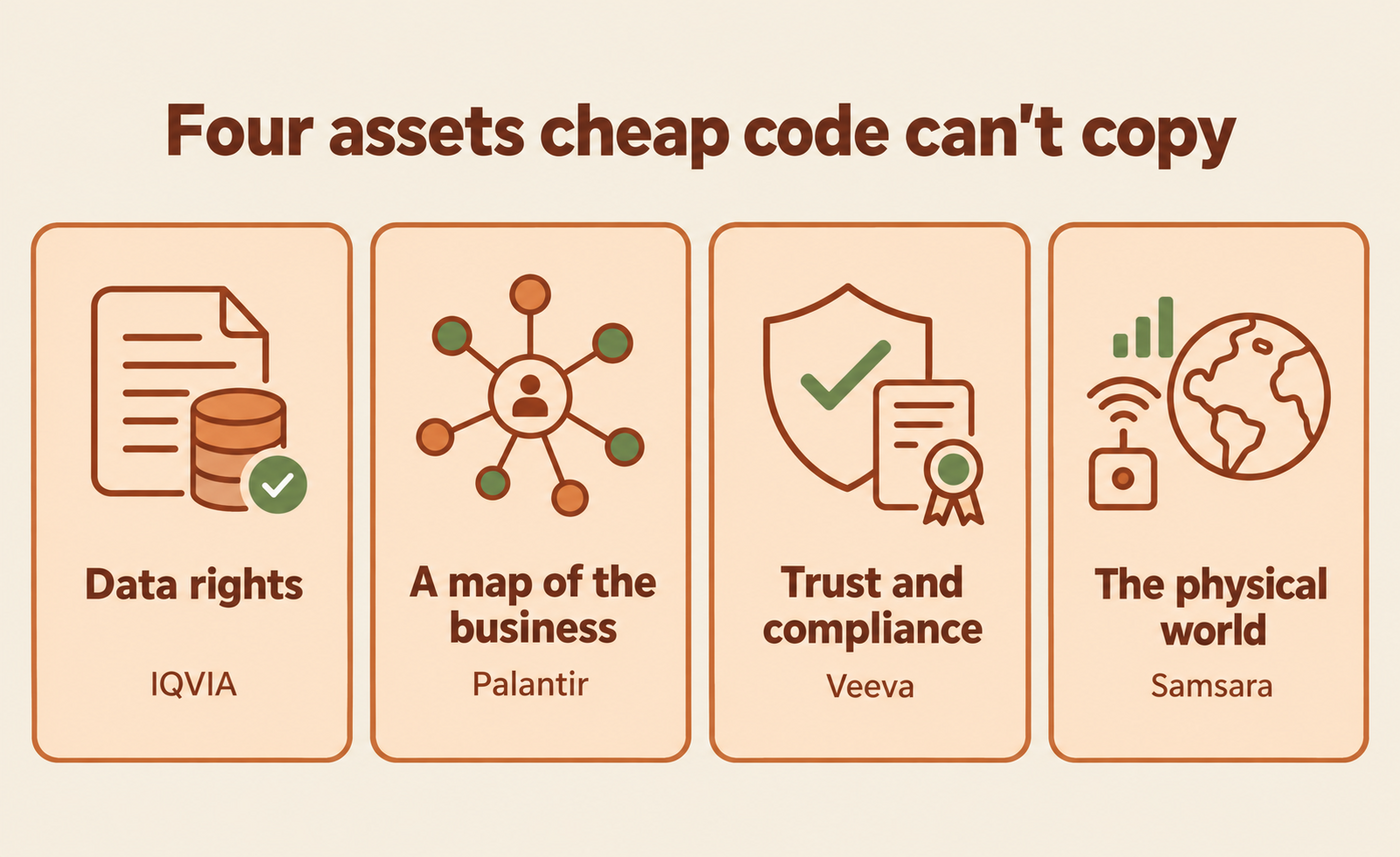

As AI makes features cheaper to reproduce, code alone protects a software company less and less. The advantage may shift to the companies that control what makes software useful: data they have the right to use, a map of the customer’s business, trust and compliance, and equipment in the physical world. Here is how that could work, who keeps the gains, and three questions to ask before you buy, build or invest.
On 7 October 2026, developer Brandon Thomas released seven free, experimental alternatives to Adobe’s applications, including Photoshop, Premiere and Lightroom, which he says he built with AI. Hands-on tests of the project, called ArtCraft, found big gaps.
Even so, on 13 October 2026 HSBC cited it when it cut Adobe’s shares to Hold, worried that amateur users might leave. Adobe’s sales are still growing, yet its shares were down about 28 percent for the year at the close on 15 October 2026.
My reading: when software gets cheaper to build, the advantage may shift to the companies that control the data, relationships and equipment that make it useful.
Software that fits the user: from block to blob

I’ve been living a small version of this since February 2026, when I started adapting OpenClaw, an open-source AI assistant, into tools for my own work (TinkerClaw). I asked it to reshape itself around the way I work, and it kept doing it.
A PDF reader. I review long documents, so I took the closest open-source PDF viewer and had an AI add text-to-speech and a button that sends my notes straight to an agent. The notes I write on a page become changes in the document within minutes. This article went through that loop about a dozen times.
A git visualizer. At work we run software on machines spread across sites. I took an open-source tool that draws git history and had it reshaped to track the company’s machines instead: which one has changes that sat uncommitted for a long time, and which one is still running an old version.
An email reader. Running day-to-day operations, I kept missing the mail that mattered. So I had an AI build me a reader that sorts mail by topic and ranks it by what I am working on, not by date. For each topic it prepares the work and shows me a reply ready to approve and send. It summarises long threads, and it learns my preferences and where I stand on each project and with each person.
I’ve come to see that software is now elastic. When I notice that a tool I use could fit my workflow better, I vibe-code the change myself: I describe it to an AI in plain words, it edits the code, I test it and keep what works. I call this the move from block to blob: from a finished product everyone receives the same way, to something that morphs its shape to each user’s needs.
Changing a screen is the easy part, though. Building an application that works is harder, and running a service other people can depend on is harder still. If you are not using a cutting-edge model, write a specs bible before you start: one document that says what the program must do, what must never change, and how to test it, kept up to date with every change. Older models tend to break things, especially features you built weeks ago. With the bible, you can ask the AI to check whether anything is broken, or point it to the full spec when you spot a problem, without explaining the feature all over again.
Where you will see it first. Some kinds of software will feel this much sooner than others. Each example below belongs to one of the clusters investors hold, which I go through one by one further down.
- Software sold with ordinary machines. In factories, suppliers of fairly standard equipment, such as conveyor belts, often sell their own control software under a licence, with a monthly fee or a charge per user. For some of them those licences have become the main source of revenue, more than the steel. When someone can reverse-engineer the control screens with an AI and replace them, that revenue is exposed, and I expect it to be disrupted sooner rather than later. The machine, its safety certificates and the technician who comes when it stops are much harder to replace. (Cluster: industrial and machine software.)
- Office software sold per seat. Sales, support and project tools, and business systems such as ERPs, the programs that run orders, stock and invoices, are usually priced per person. I already see companies buying a single seat and letting an AI work through it for many people, or rebuilding the screens they need around it. Licence terms often forbid this, but it shows where the pressure is going. (Cluster: seat-based business apps.)
- Customer support desks. Help-desk software is usually charged per support agent. When an AI answers the first round of questions, a company needs fewer agents, and so fewer licences, even while it handles more customers. (Cluster: seat-based business apps.)
- Booking and invoicing for small businesses. A hairdresser or a physiotherapist pays every month for a booking tool built for everyone. Soon they will be able to describe the tool their own shop needs and have it built. A self-employed electrician or plumber will send quotes and invoices, and even keep the books, through a simple WhatsApp automation, while they get on with the work that earns them money. (Cluster: software for small businesses.)
- Simple websites, forms and surveys. A shop’s website, a sign-up form or a customer survey used to mean a monthly plan with a builder. Now you describe what you want and an AI writes it, and hosting a small site costs very little. (Cluster: software for small businesses.)
- Photo and video editing for hobbyists. Many amateurs pay a monthly subscription for professional tools and use a fraction of them. Free editors built with AI, like the ArtCraft tools above, already cover a lot of that fraction. Professionals, who need file compatibility, plug-ins and support, will stay longer. (Cluster: creative tools.)
- The spreadsheet that grows up. Many teams run on a shared spreadsheet that became too big, fed by files exported from banks, machines or suppliers. An AI can turn it into a small app with proper forms, checks and the dashboard the team always wanted. In some cases that app becomes the seed of a full-blown ERP, the kind of system that runs a company’s orders, stock and invoices. (Cluster: seat-based business apps and data owners.)
- Your own data. Banks, fitness watches and utility companies let you download your data. With an AI you can turn those files into the dashboard you always wanted, without waiting for the company to build it, or paying an analytics add-on for it. (Cluster: data owners.)
- Apps for smart-home gadgets. Every brand of lights, plugs or thermostats wants you in its own app. More and more people connect them to one open platform, such as Home Assistant, and ask an AI to write whatever connection is missing. The gadget maker keeps the hardware sale and loses the app. (Cluster: consumer devices and their apps.)
Try it yourself. Pick one small annoyance in a tool you use every day. Find a free, open-source program that does roughly the same job, and ask an AI coding assistant to change it the way you want. Notice which part was easy and which part you would not trust to keep running without you.
Why cheaper code can make some companies stronger

If an AI can copy the features, investors ask a fair question: what are customers paying for? My answer is that some software companies never kept their value in the code alone.
When writing software gets cheap, a company that already controls something hard to get (moat) can build many more useful things around it, quickly and cheaply. Its rivals can write the same code, but they can’t easily attach it to the same asset.

For an investor, “hard to copy” is only the first of three tests:
- Scarcity. Is the asset hard for a rival to get, even with cheap code?
- More demand. Does cheap code create more paid uses of that asset?
- Value capture. Does the company keep a fair share of the gain, or do customers, suppliers and rivals take it?
Arriving first can pass the scarcity test on its own. In winner-takes-all markets, users stay where the other users already are. A rival could have copied Facebook‘s code years ago and still couldn’t copy the friends everyone had there. The lead isn’t permanent though: TikTok took a large share of people’s time with a different kind of product, and cheap code will make challengers like it easier to build.
An asset can pass the first test and fail the other two: it protects the company from being displaced, and earns it nothing extra. Each of the four assets below passes the first test and is at risk on a different one. The company figures show how each business is doing, and they don’t prove that AI is the cause.
1. The physical world
My day job is building industrial vision systems, so this is the part I see every week. AI can help write software that spots people or objects in camera images. It cannot mount a camera above a loading dock, keep it working through dust and vibration, prove to a safety inspector that the system reacts in time, and fix it when it doesn’t.
Samsara, an American company that sells fleet and equipment tracking, connects trucks and machines to software, and says its network collects more than 25 trillion data points a year. Once the sensors are installed and paid for, every new AI feature can be sold to the whole fleet without installing anything new. That is the “more demand” test, passed in theory.
In its fiscal year to January 2026, Samsara’s revenue grew 30 percent, to 1.62 billion dollars, its recurring revenue reached about 1.89 billion dollars, and it still recorded a small net loss.
What would break it. Customers own their data and can export it. If they send it to a cheaper rival’s AI while Samsara keeps paying for the hardware and the service, Samsara keeps the expensive part and loses the profitable part.
2. Trust and compliance
Companies in regulated industries such as drug-making need software they can prove is under control. They buy features, and they also buy validation evidence, controlled updates and support. Replacing that means redoing the checking, documenting and approving, and a weekend of coding doesn’t do it.
Veeva sells exactly that to life-sciences companies. Its revenue for the fiscal year to January 2026 grew 16 percent, to about 3.2 billion dollars. An application that runs inside an environment the customer has already validated costs much less to approve than one built from scratch, so cheap code could mean more paid applications on the same base.
What would break it. Much of Veeva’s software is priced per named user, according to analysts who study its contracts. If AI agents do the work of people, customers need fewer seats, and a strong position could still bring in less. The trust would be intact while the pricing works against it.
3. Data the company has the right to use
The data itself isn’t magic; access to it is. IQVIA, which sells health-care data to drug companies, describes in its annual report large networks of patient data supplied under long-term commercial agreements. Generating code does not recreate those contracts or the legal right to use what flows through them, and cheaper analysis tools could increase the demand for licensed data.
What would break it. The same report notes that suppliers can restrict how their data is used or raise their prices. If the suppliers capture the gain, IQVIA is a pipe.
4. A map of how the customer’s business works
Palantir‘s Ontology, a core layer of its software, connects a company’s data to the real things it describes: plants, products, orders, trucks, and the rules and permissions around them. Building that map means wiring in the customer’s data, rules and permissions, and it takes time. My argument is that every new AI agent in a company raises the value of one shared, trusted map that all of them read from. In August 2026, Palantir forecast 82 percent revenue growth for 2026.
What would break it. AI could make the wiring itself much faster, and then the map is easier for a rival to rebuild.
Who keeps the savings?

The third test depends on how a company charges. Many business applications charge per licensed user. If automation means a customer needs fewer licences, that revenue can fall unless more customers, more usage or other charges make up for it. I already see companies buying a single seat and letting an AI work through it for many people, although licence terms often forbid it.
Fin, called Intercom until May 2026 and bought by Salesforce in September 2026, went the other way. Its AI agent charges 99 cents per billable outcome, some handoffs to a human included. More outcomes bring in more revenue at the same price.
The price per outcome can still fall, as in this made-up example: 1,000 outcomes at 99 cents bring in 990 dollars, while 2,000 outcomes at 40 cents bring in 800. Cheaper code also leaves the other costs in place, such as running the AI, support, validation and installation, and those can eat the savings.
Where investors’ money sits, cluster by cluster
Investors rarely buy one software company; they buy clusters of companies that share a trait. The software sell-off of early 2026 cut the sector’s weight in the S&P 500 from about 12 percent to 8 percent, according to StashAway’s chief investment office on 30 April 2026, and it hit some clusters much harder than others. In iShares’ IGV, a widely held software fund, the largest holdings at the end of June 2026 were Palo Alto Networks, Microsoft, Palantir, CrowdStrike and Oracle, followed by Salesforce, AppLovin, Cadence Design and ServiceNow.
Here is how I read the clusters behind those names, through the same three tests. It is my reading, not advice.
- Seat-based business apps (Salesforce, ServiceNow, Workday). They sell software per user to run sales, IT requests and staff records. They are the most exposed to the seat problem: when AI agents do the work, customers buy fewer seats. What protects them is the customer data and the workflows they already hold. Watch whether they move from charging per seat to charging per task done or per dollar earned.
- Cybersecurity (Palo Alto Networks, CrowdStrike). Cheap code helps attackers as much as anyone, so demand for defence grows. The hard part is trust and the people who answer at three in the morning during a breach. It would break if AI tools made detection a cheap commodity.
- The clouds and platforms underneath (Microsoft, Oracle). More software means more software to run, and these companies own the computers and the databases it runs on. Their exposure is the per-user part of their business, such as office licences. Two risks sit on top. If writing software gets cheap enough, whole new operating systems for PCs and phones could start entering the market, and Windows would face rivals it hasn’t seen in decades. And in AI, Microsoft’s Copilot runs mostly on models from OpenAI and Anthropic, not its own, and in my use it often feels a step behind what those labs sell directly. Microsoft has the data centres, the customers and the distribution to ride this wave, yet it rents the part that matters most. Has it already lost the race? Could it still catch up?
- Creative tools (Adobe). Amateurs leave first, as the ArtCraft story shows. Professionals stay for file compatibility, plug-ins and support. The question is how much of the revenue comes from each group and if the alternatives are good enough.
- Chip and engineering design (Cadence, Synopsys, Autodesk). Their tools are checked against the processes of the factories that make chips or parts, and a design signed off with them is trusted. That is the trust-and-compliance asset again, and cheaper code mostly makes their customers design more.
- Software for small businesses (booking, ordering and invoicing tools). The hairdresser and the electrician above live here. The screens are easy to replace; moving the customer’s money, with the licences and fraud checks that requires, is not. Companies that take a cut of payments are safer than those that only charge a subscription.
- Industrial and machine software. Covered in the conveyor-belt example above: control screens and reports sold as licences are exposed, while safety-certified control, the installed base and field service are not. Industry-savvy investors will know which suppliers in their portfolio earn more from the licence than from the machine.
- Advertising and matching engines (AppLovin). They decide which ad, app or offer reaches which person. Cheap code means many more apps competing for the same users, which makes good matching more valuable. This is the cluster closest to the idea in the next chapter.
- Data owners (IQVIA, and financial data firms such as S&P Global and MSCI). Covered above under data rights: cheaper analysis tools tend to increase demand for licensed data, unless the suppliers take the gain.
Who gets paid when users improve the product?

This part is a hypothesis: I am not a futurologist, and this is what I see from where I stand today.
If people reshape the tools they use, a handful of fussy users will build things that many others want. One builds a booking flow for a particular trade; a thousand others in that trade would use it, but they can’t judge its code or maintain it. The valuable work becomes collecting what the fussy built, keeping it working, and bringing it to the rest, while still tailoring for the special case.
Open source already does half of this. Pull requests are the standard way to collect changes from contributors, the fussy users of their day, review them and fold the good ones into the main version. What git doesn’t cover is the last mile: a version tailored to each user, a way to find the right one, and someone keeping it working as the main version moves on. People differ: one user wants a feature one way, another wants it the opposite way, and both are right for themselves. A product could build that last mile in, with a lot more engineering, but then it is no longer git. Will there ever be a git 2.0 that covers it?
The news industry walked this road first. The newspaper gave everyone the same copy; the internet brought personalised feeds. The end of that road (the last mile) is a service that brings each reader what matters to them, sometimes before they knew they were looking for it. At that point the matching itself is the valuable part, the way matchmakers who in some countries still help families find a bride are valued and trusted. Today’s ad companies are the opposite: such a nuisance that people install ad blockers.
I see software heading the same way: a shared core, a growing library of variations its users have made, and a platform that matches each person with the version that fits them. That platform would:
- test that a variation works with the current core;
- manage its permissions and updates;
- recommend it to the users it suits;
- pay the person who built it.
A two-sided market. On one side sit the users who want variations. On the other sits everyone who wants to reach them: the people who build variations, and companies that pay to have their connector, service or plug-in matched to the users who need it. That is advertising turned on its head. The ad stops being noise and becomes a resource, because it arrives only when it fits. And a resource can be sold: the platform could charge the customer as well, for bringing them exactly what they need.
There are precedents: Shopify lets developers sell apps to its merchants and keeps nothing on a developer’s first million dollars of lifetime revenue, then 15 percent. Roblox lets creators turn what they earn into real money. Neither shows that people will pay for personalised business software. What would be new is how cheap it becomes to make a useful variation, and how much a good match is then worth.
What would break it. Variations that clash with each other, builders who abandon them, insecure code, unclear rights, recommendations that can be bought, rewards for quantity over usefulness. And the hardest question: why would anyone pay for a maintained variation when generating another one is cheap? My answer is that they pay for the part that keeps working, the same reason they pay Veeva or Samsara. It is also why Toyota could walk its competitors through its factories and show them just-in-time production: seeing the method is not the same as running it.
Where the argument breaks

All of this cuts both ways. A rival gets the same cheap code, can hire the same specialists and can copy outcome pricing, and AI could make it easier for customers to take their data and leave. None of these assets is safe for good: a company has to keep defending it, and some will lose it.
A strong business is also a different thing from a good investment. The share price may already assume the growth.
The most exposed are general-purpose tools that charge for each user and hold little a customer couldn’t take elsewhere, and machine makers whose licences earn more than their machines.
Being easy to describe doesn’t make a product easy to replace, though. Run the same test on Adobe: would a free copy keep the file compatibility, professional workflows, plug-ins and support that studios depend on?
Three questions before you buy, build or invest

- If a capable AI rebuilt the product this weekend, what would the copy be missing?
- Does the company’s revenue go up or down when its customers’ AI gets better?
- If the software got something wrong, who would the customer call, and would that call still need this company?
A five-minute exercise. Pick one subscription you pay for. Write down what a free AI-built copy would lack, and who you would call when it fails. If both answers are empty, you are paying for code.
Good answers don’t make a company immune. They mark one worth a closer look: a company whose data, services or equipment stay essential while customers reshape the software around them.
Oscar Serra builds TinkerClaw, a modified version of OpenClaw with its code publicly available, and writes about it, with it, at thetinkerzone.com. Figures checked on 16 October 2026.
Everything on the site, by topic or date: Browse the Tinker Zone
Leave a Reply