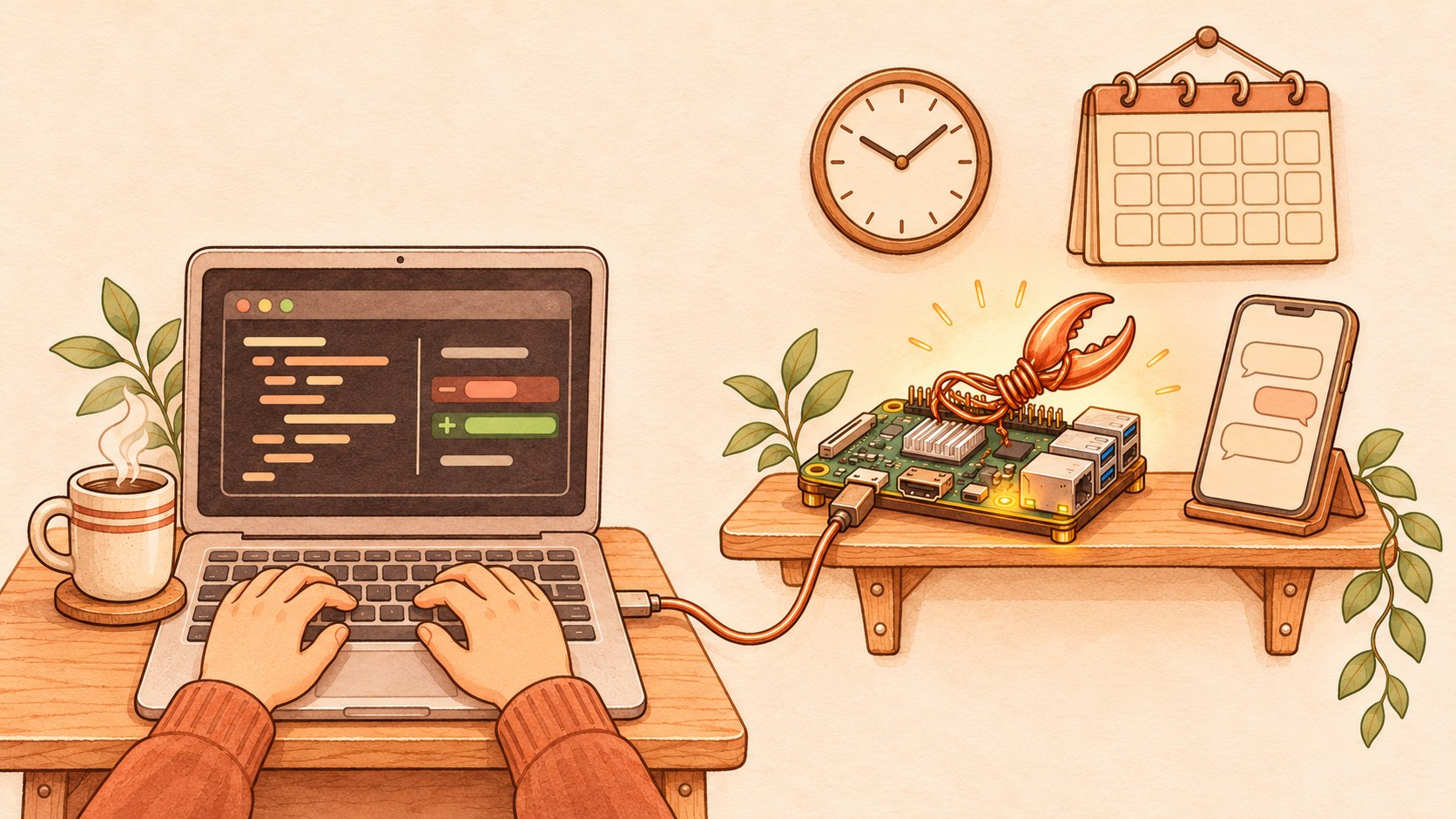

OpenClaw or Claude Code? One question decides which to install first: will you talk to this agent from your keyboard, inside a code repository, or from your phone, about everything else? Keyboard and repo: install Claude Code. Phone, chats, schedules and the rest of your day: install OpenClaw.
They look like rivals because both are AI agents that read files and run commands. They are built for different places. Claude Code is a coding agent that sits in your project while you work. OpenClaw is a gateway that stays on when you are not there and answers in the chat apps you already use. We have run OpenClaw day and night since 31 January 2026 and use Claude Code every day, and the two now work as one system on our machine. Most comparisons that rank for this search were written from feature tables, and several miss what Claude Code added in 2026: chat channels, scheduled tasks in the cloud and Remote Control. Those change the answer less than you would think.
OpenClaw vs Claude Code at a glance
| Claude Code | OpenClaw | |
|---|---|---|
| What it is | Anthropic’s coding agent | Open-source agent gateway (MIT), formerly Clawdbot and Moltbot |
| Where it runs | Your terminal, IDE, desktop app or the web, in one project | A service on your own machine or server, always on |
| How you reach it | The session you have open; Remote Control from a phone | WhatsApp, Telegram, Slack, Discord, Signal, iMessage and more |
| Models | Claude only | Any provider, local models included |
| Scheduled work | /loop in a session, desktop tasks, or cloud tasks against your repos |
A built-in cron that runs on your machine, with your files |
| Memory | CLAUDE.md files and auto-memory per project |
Plain files for personality, rules and memory, shared by every chat |
| Price | Pro $20 a month, Max $100, Ultra $200 | Free software; you pay for the model and the machine |
| Best at | Changing code safely | Being reachable and doing jobs while you are away |
What each one is
Claude Code is Anthropic’s agent for software work. You start it in a repository, describe a change, and it reads the code, edits files, runs the tests and shows you the diff. It asks before it runs a command or writes a file unless you allow more, and plan mode lets it propose a plan before touching anything. It runs on Claude models only, through a Claude plan or an API key. The Free plan does not include it; Pro does, at $20 a month or $17 billed yearly (claude.com/pricing, read 22 November 2026).
OpenClaw is a free, open-source agent that runs as a service on a machine you control, from a Raspberry Pi to a cloud server. It talks to whatever large language model you connect and reaches you through messaging apps, so you can text it like a person. It keeps a schedule, keeps its personality and memory in files you can read, and learns new jobs from skills. It was called Clawdbot and then Moltbot before January 2026; our OpenClaw review covers what months of running it are like.
When Claude Code wins
Changing code you care about
This is the job Claude Code was made for, and it shows. The loop of reading the code, making a change, running the tests and fixing what broke is tight, and every edit comes back to you as a diff you can accept or reject. Subagents take side tasks such as a search across the codebase without filling the main context, and hooks run your own checks before or after a tool call. For a refactor across twenty files, it is the tool we reach for. OpenClaw can edit files too, but it has no review loop like that.
Getting started in minutes
One install, one login with your Claude plan, and you are working. OpenClaw asks for more: a machine that stays on, a model provider, a chat channel to pair, and some care about what it may touch. If you want an agent working tonight and only have tonight, Claude Code gets you there.
A bill you can predict
A Claude plan covers Claude Code within its usage limits, so a heavy day does not turn into a surprise invoice. We measured how much work each plan holds in Claude Code pricing. The skills worth adding once you settle in are in Claude Code skills.
What changed in 2026, and where it stops
Claude Code now reaches past the terminal. Channels push messages from Telegram, Discord and iMessage into a running session, Remote Control lets you continue a session from your phone, and scheduled tasks run Claude Code on Anthropic’s cloud on a timer or a GitHub event (channels, Remote Control, scheduled tasks). All three are useful, and all three keep the session at the centre. Channels are a research preview, and messages only arrive while the session is open. Remote Control needs your computer on and the claude process running. Cloud tasks see your repositories and connectors, not the machine in your house. If what you want is a coding session that follows you around, this is enough.
When OpenClaw wins
It is on when you are not
The gateway is a service, so a message sent at seven in the morning from a bus finds it awake. Nothing has to be open on your desk. That one property is what turns an agent into an assistant: you hand it something from your phone and it answers in the same chat.
Work on a timer, on your own machine
Our OpenClaw runs 21 scheduled jobs today, from a morning briefing on WhatsApp to a nightly memory tidy-up, a daily look for security updates and a weekly look at the backups. Each one runs on our machine, with our files, and reports in a chat. Claude Code’s cloud tasks cannot see those files, and its local loops stop when the session closes.
Any model, including the cheap ones
OpenClaw does not care whose model you use. You can put a small, cheap model on routine checks, a frontier model on hard thinking, and a local model in Ollama on anything private. Claude Code runs Claude only, so even a job that reads a feed and says “nothing new” is paid at a Claude rate. The model dial post shows how that choice is made per task.
Reach into the rest of your life
Chats, mail, calendars, a smart home: OpenClaw connects to the things you already run, through channels and skills. Our Home Assistant AI setup is one example of an agent that waters the garden and answers from a chat. The price of that reach is that security is your job: an agent that reads messages from outside can be talked into things, so it needs narrow permissions, its own accounts and guards on what it may do.
Why we run them together
The best setup we have found uses each for what it is good at. OpenClaw is the front door and the clock: it holds the chats, the schedule, the memory and the choice of model. Claude Code is the engine for heavy thinking. OpenClaw can drive Claude Code directly: its docs describe running Claude Code as an external harness through ACP, and as a CLI backend for ordinary turns (OpenClaw docs).
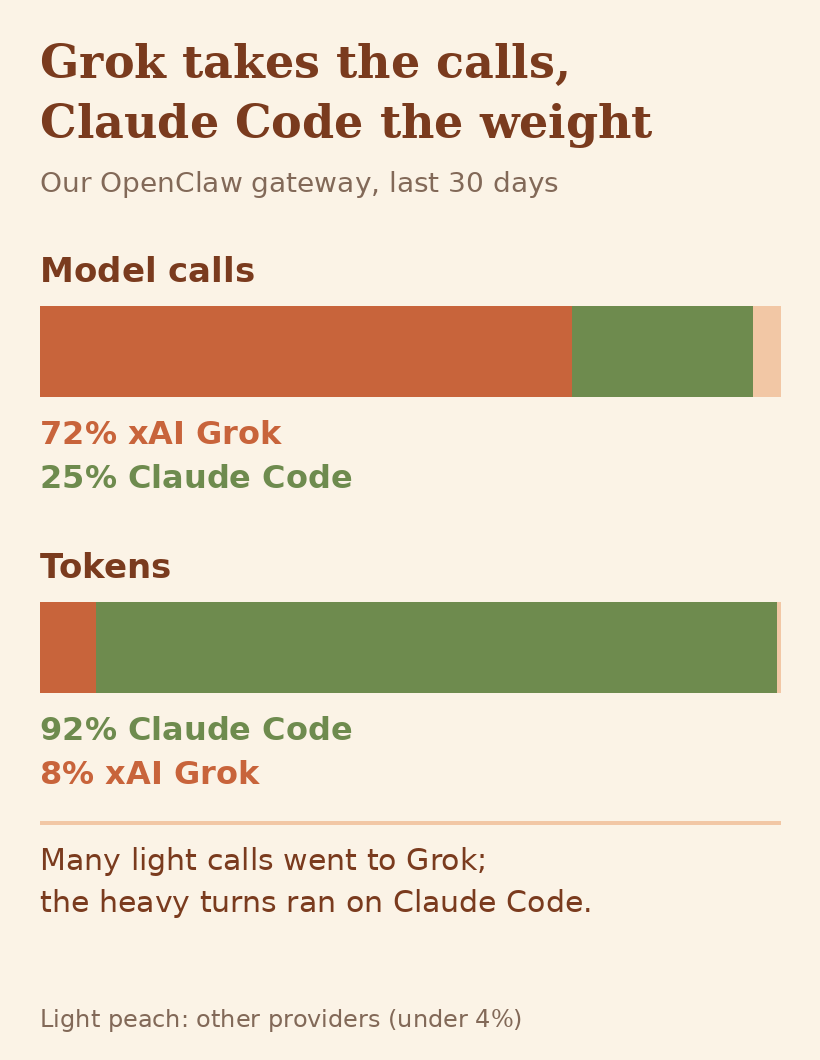
Our gateway’s own log shows the split. In the last 30 days, 72% of its model calls went to xAI’s Grok models. Those calls were many and light: 92% of all the tokens went through Claude Code, on the long turns that needed real reasoning. Grok takes the volume and Claude takes the weight. Claude Code alone cannot make that split, because it only runs Claude. Our Smart Model Router skill is a guide to making it in your own install.
When the work is code, we still open Claude Code in the repository, at the keyboard. That is where its diffs and permission prompts earn their keep.
One caveat before you copy this: Anthropic’s rules on using a Claude plan inside other tools moved three times this year. It blocked third-party harnesses on 4 April 2026 (VentureBeat), announced a separate credit for them, and paused that change on 15 June. Its help article, last updated on 7 October 2026, says the Agent SDK, claude -p and third-party app usage draw from your plan’s limits (Anthropic). Read it again before you build on it.
Which one should you install first?
Go back to the question at the top. A developer who spends the day in a repository and wants help with the code: Claude Code, tonight. Someone who wants “remind me, watch this, answer my WhatsApp, water the plants at six”: OpenClaw, on a small machine that stays on. Add the second tool when you catch yourself wishing the first could do its job; the two fit together without a fight.
If money decides it, the software side is simple: OpenClaw is free and its bill is the model you pick, which we broke down in OpenClaw cost per month. Claude Code starts at Pro’s $20.
FAQ
Can I use my Claude subscription with OpenClaw?
Yes, as of Anthropic’s help article updated on 7 October 2026: third-party app usage, the Agent SDK and claude -p draw from your plan’s usage limits. The policy changed three times in 2026, so read that article again before you rely on it. An API key always works and is billed per token.
Is OpenClaw better than Claude Code for coding?
No. Claude Code is the better coding agent: tighter edit and test loop, diffs to review, permission prompts and plan mode. OpenClaw is better at everything around the code, and it can hand a coding task to Claude Code through ACP.
Can Claude Code replace OpenClaw now that it has channels and scheduled tasks?
For a developer who only needs Telegram, Discord or iMessage into an open session, maybe. It cannot if you need WhatsApp or Slack, local or non-Claude models, or jobs that run around the clock on your own machine and files. Channels are a research preview and only deliver while the session is open.
Is OpenClaw or Claude Code safer?
Claude Code, out of the box. It works in one project and asks before it acts unless you allow more. OpenClaw reads messages from the outside world and can reach mail, files and accounts, so prompt injection and untrusted skills are real risks. It is as safe as the permissions you give it.
Do I have to pay for both?
OpenClaw is free; you pay for the model and the machine, and a Raspberry Pi is enough. Claude Code needs a Claude plan from $20 a month, or an API key. If you already pay for a Claude plan, both can run on it.
What we changed in TinkerClaw, and why
Running the two together is the reason TinkerClaw, our open-source build of OpenClaw, ships a bridge that runs the agent’s chats through the real Claude Code, signed in with your own login and wearing your agent’s own identity. It keeps OpenClaw’s channels and schedule, adds one dial for the model per task and a panel that shows the bill per call, and keeps background work running after you close the laptop. I tinker with ideas like these all the time and bake them into the code the moment I need them in my day.
You can click through it in the live demo, and our review of OpenClaw explains what months of daily use taught us about the engine underneath.
For builders
- THALAMUS (PDF): how to pick which model answers each turn; the paper behind Why we run them together.
- SEAHORSE: what makes an agent code well: finding out what is already true before acting, on a harness that gives it the right tools; behind Changing code you care about.
- AEGIS (PDF): layered defences for an agent that reads messages from outside; behind Reach into the rest of your life.
- There are others, by topic, in the brain map and the site map.
Leave a Reply