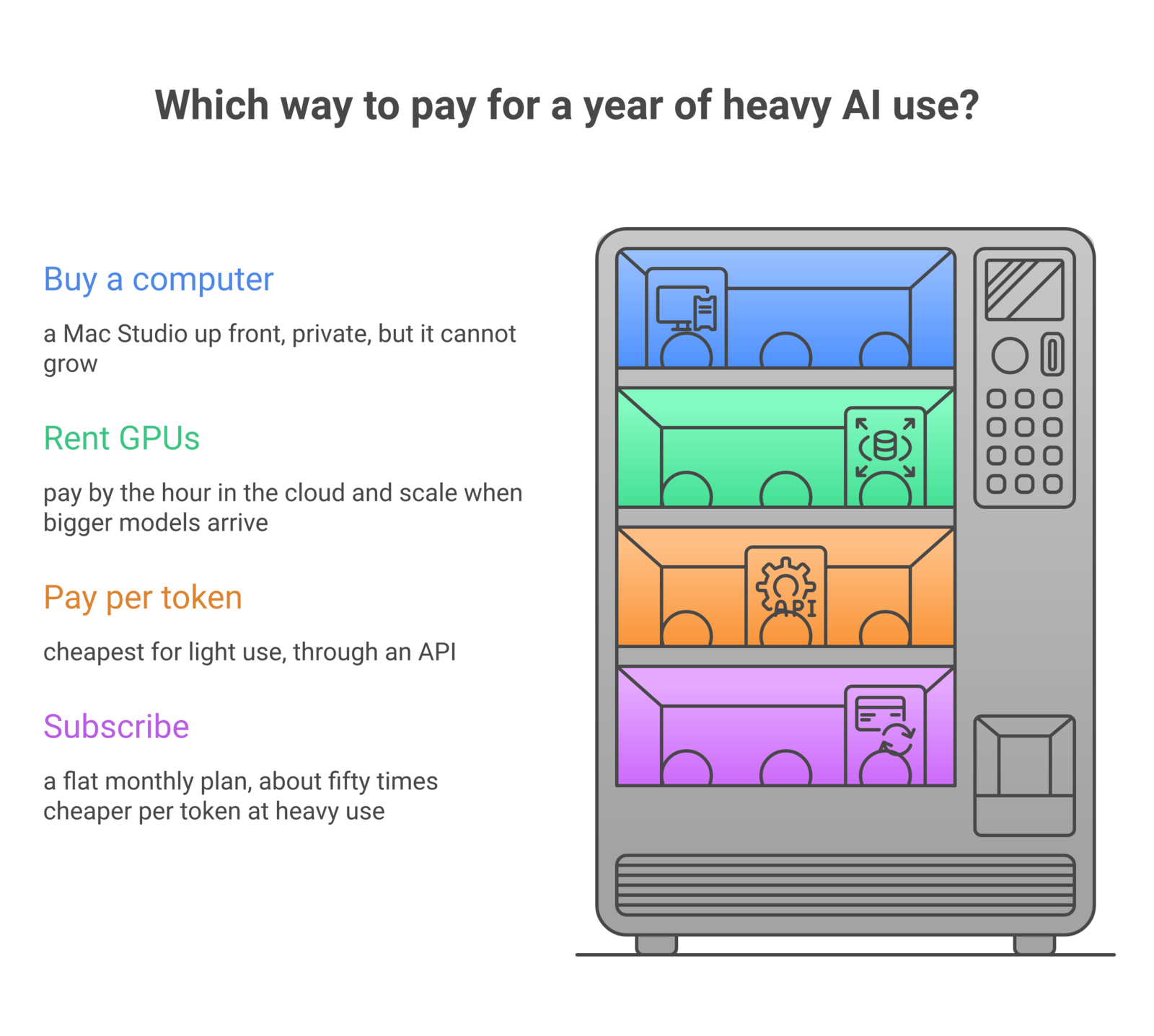

Four ways to pay for the AI you use
Short answer: Pay-per-use AI services usually bill by the token, a piece of text about three quarters of a word long. In our reading-heavy example, a heavy user paying per token for a large open model spends about $930 to $1,900 a year. A $10,000 computer that runs the same model costs about $5,200 to $5,600 a year spread over two years, or $2,700 to $3,100 over four, including electricity. Owning only costs less above roughly 14 to 30 million tokens a day, and tests of the previous Mac Studio suggest the two-year case would ask more work than a day holds; nobody has tested the new one. So for this workload, paying per use costs less. If a smaller model on a computer you already own does the job, the answer changes.
The terms you need, in one minute
| Term | What it means here |
|---|---|
| Token | The unit AI services bill by: a piece of text, about three quarters of an English word. |
| AI agent | An AI that works through a task step by step, for example writing and testing code. It can process its earlier messages, files and results again and again, so a heavily used agent can process millions of tokens a day. |
| API | A connection that lets software use an AI service. The examples here charge per token used. |
| Open model | An AI model whose files you can download and run yourself, such as Qwen (Alibaba) or Llama (Meta). The closed models behind ChatGPT or Claude cannot be downloaded. |
| GB of memory | Gigabytes of working memory. A model has to sit in it to run at a useful speed. Many laptops have 16 GB; a large model needs 200 GB or more. |
| GPU, H200 | A GPU is the chip that runs AI. The H200 is Nvidia’s data-centre GPU with 141 GB of memory, usually rented by the hour. |
| kWh | A kilowatt-hour, the unit on your electricity bill. A computer drawing 150 watts all year uses about 1,314 kWh. |
What a year of AI costs, four ways
These are example yearly budgets for one heavy user, such as a developer whose AI agent writes and checks code for much of the day. The hardware and pay-per-use rows use the same model family and version, Qwen 3.5; compression and server settings can still change the results, and we have not tested that they do equal work. Subscriptions give you different, closed models, so they sit apart.
What a year of heavy AI use costs
Example budgets, not equal amounts of work · US dollars per year · token rows: 20 tokens read per token written, no discount for repeated text
First six rows: one downloadable AI model, Qwen 3.5
Different, closed models, with usage limits
1. Buy a computer: $5,200 to $5,600 a year over two years
Our example uses a Mac Studio (M5 Ultra) with 256 GB of memory, listed in the US at about $9,500 to $11,300 depending on configuration; we round to $10,000. You pay it on day one. The yearly figure spreads it over an assumed replacement period: two years, or four if it keeps running models that meet your needs. Resale value would lower the cost. The ranges in the chart vary only electricity; with the full purchase range, the two-year cost is about $4,900 to $6,300.
Electricity depends on where you live. Apple quotes 9 W idle and 385 W at full load for its 512 GB model, in its own tests, not while running AI. We did not find a measurement of this model running AI, so we assume 150 W around the clock. The table uses household prices including taxes: EU figures from Eurostat for July to December 2025, the US average from the EIA for July 2026. Hungary and Ireland are the cheapest and dearest EU countries; prices inside the US vary nearly as widely.
| Where | Price per kWh, with taxes | Mac at 150 W all year |
|---|---|---|
| Hungary (cheapest in the EU) | €0.108 | $160 |
| United States (average) | $0.183 | $240 |
| European Union (average) | €0.290 | $440 |
| Ireland (dearest in the EU) | €0.404 | $610 |
Running locally can keep what you type on your own computer, as long as the tools around the model run locally too. The purchase price is fixed; electricity and repairs are not.
2. Rent a computer: $4,600 to $30,900 a year
Renting works like renting a car: open an account with a GPU cloud, choose a machine, start it, and pay by the hour until you stop it. Storage for your files is usually billed even while it is stopped. Our example uses two H200s for this compressed model. Amazon’s cloud (AWS) rents H200s eight at a time, at a much higher hourly price. Smaller GPU clouds rent them one at a time:
| Provider | What it is | One H200, per hour (checked 8–9 Oct) |
|---|---|---|
| Prime Intellect | Rents GPUs from many clouds through one account | from $3.14, cheapest listing we found |
| RunPod | GPU cloud for developers | $5.29 on its main H200 card |
| Vast.ai | Marketplace of independent hosts; price and reliability vary by host | about $4.30 |
Prices are per GPU and availability changes daily, so check that a two-GPU machine is actually offered before you plan around it. Two of them for 8 hours a day come to $18,300 to $30,900 a year; for 2 hours a day, $4,600 to $7,700. Renting suits work that needs full control of the machine, a custom setup or a burst of capacity, and compute charges stop when you stop an on-demand machine, though stored files can still cost money.
3. Pay per use: about $930 to $1,900 a year
Services such as OpenRouter connect you to companies that host open models and bill you per token. For Qwen3.5-397B-A17B, the large version used throughout this article, Alibaba Cloud, one of the hosts OpenRouter lists, charges $0.39 per million tokens the model reads and $2.34 per million it writes, plus a 5.5% fee when you buy credits. The mix of reading and writing matters more than anything else here. Our baseline assumes 20 tokens read for each one written, with no caching discount (caching means reusing text the service has already processed, often at a lower price):
| Tokens read per token written | Price per million tokens | 10 million tokens a day, one year |
|---|---|---|
| 20:1 | $0.51 | $1,900 |
| 5:1 | $0.75 | $2,800 |
| 1:1 | $1.44 | $5,300 |
Counting only 260 working days, 5 to 10 million tokens a day cost about $660 to $1,300 a year. If privacy matters, OpenRouter can send your requests only to hosts that promise not to keep them, but your text still leaves your computer.
4. Subscribe: $240 to $2,400 a year for the plans shown
| Plan | Per month | Typical use | API credit included |
|---|---|---|---|
| ChatGPT Plus, Claude Pro, Google AI Pro | about $20 | daily chat and light work | no |
| ChatGPT Pro, Claude Max 5x | $100 | regular agent work | Claude: $100 a month |
| ChatGPT Pro, Claude Max 20x | $200 | heavy agent work | Claude: $200 a month |
OpenAI also sells a $500 tier, annual billing can cost less than twelve monthly payments, and every plan has usage limits that depend on the model and the task. Since 7 October, Claude Max includes monthly API credit for your own software: $100 on Max 5x, $200 on Max 20x, expiring each month; you claim it by linking an Anthropic Console account, seven days after subscribing. It pays for Claude models through Anthropic’s API, not for Qwen or other providers.
We meter our own use. Between 9 and 10 October, about 30 hours of agent work on Claude Max 20x used 67% of that week’s allowance, and the same work would have cost $2,110 at Anthropic’s list prices, cached text included. If that week repeated every week, the plan would deliver about 46 times its monthly fee in list-price value; using the full allowance every week, about 68 times. That is one user’s estimate, not money anyone would otherwise have spent.
When does owning the computer cost less?
On cost alone, the Mac wins above about 28 to 30 million tokens a day if you replace it every two years, or 14 to 17 million if you keep it four. Both assume the Mac can actually do that much work.
Can a Mac really do that much work?
Can one Mac do that much work in a day?
Illustration using the previous Mac Studio (M3 Ultra): hours of work needed to process enough text for owning to match paying per use
reading writing 24 hours: all the time a day has
A community speed test of Qwen 3.5 on the previous Mac Studio measured 389 to 493 tokens a second reading short texts and 25 to 37 writing, falling to 18.5 in a long conversation. Reading and writing share the same machine, so their times add up. At those speeds, the two-year break-even would need 27 to 36 hours of work a day: more than a day holds. The four-year break-even would need 15 to 20 hours, possible on paper. These tests ran one conversation at a time: caching and parallel conversations could raise the real capacity, and long agent conversations could lower it. As of 13 October we found no such test of the newer M5 Ultra, so buying for this workload means betting on speed nobody has measured yet.
Which models fit at home?
Will the model fit in a $10,000 computer?
what a $10,000 Mac holds: 256 GB
The model has to sit in working memory to run at a useful speed. Qwen 3.5, released in February 2026, needs about 214 GB in Unsloth’s popular 4-bit version, which is why a 256 GB Mac is the entry point; two Nvidia DGX Sparks also reach 256 GB, but at about $6,950 each they cost more. The 2.4-trillion-parameter Qwen 3.8, released as open weights in August, would need around 1,200 GB at half a byte per parameter, our estimate: almost five times what that Mac holds. A 512 GB Mac Studio ships in late October 2026 at a price Apple has not announced. Models that do not fit can partly run from the disk, but far more slowly.
If a small model is enough, the picture changes. A model like Qwen 3.6 35B needs about 20 GB and runs on many computers people already own, such as a Mac with 32 GB or more, or a PC with a large gaming graphics card. The main extra cash cost may then be electricity; at the same 150 W all day, that would be $160 to $610 a year. How well a small model works depends on the model and the task; test it on your own work first.
Can the computer earn money while you sleep?
Darkbloom, from Eigen Labs, runs AI for paying customers on the idle time of people’s Macs, and says owners keep 95% of the revenue. Its public network figures on 13 October showed 1,128 Macs registered and 434 serving, with models up to about 35 billion parameters; the list does not include the 397B version used here. We found no dated payout data, so public evidence does not establish typical earnings or a payback period.
What could change the answer
Prices fluctuate. GPU rental prices move week to week, and model prices and capabilities change often enough to shift this comparison. Bigger home hardware is coming, starting with the 512 GB Mac Studio. Privacy rules can decide it outright: if your data must not leave your premises, a local computer is the answer and price is secondary. This Mac’s memory cannot be upgraded: future models may improve within that limit, or need more than it has.
Our take
Which one fits you?
You can combine them.
We subscribe and pay per use, and have never bought or rented a GPU. With models, chips and prices moving this fast, we prefer what we can cancel next month. To compare models by price and intelligence, see our AI cost and intelligence chart; to see what your own agents spend, per model and per session, see the Tinker Command Center.
Frequently asked questions
Is it cheaper to run an AI model locally or pay per token?
In our example, paying per token costs less. Qwen 3.5 through an API costs about $930 to $1,900 a year at 5 to 10 million tokens a day. A $10,000 Mac Studio that runs it costs about $5,200 to $5,600 a year over two years with electricity, and only costs less above roughly 28 million tokens a day. Tests of the previous M3 Ultra suggest that would be demanding; we have not verified whether the new model can sustain it. If a small model on a computer you already own is enough, running it locally can cost less.
What computer do I need to run Qwen 3.5 397B at home?
About 214 GB of working memory for a common 4-bit version, plus room for the conversation. Our example uses a Mac Studio with 256 GB of memory, at about $10,000.
Where can I rent an H200 GPU, and what does it cost?
From GPU clouds such as Prime Intellect, RunPod and Vast.ai, for about $3.14 to $5.29 per GPU per hour in October 2026, depending on provider and tier. AWS rents them only eight at a time.
How much electricity does a Mac Studio use running AI?
We found no measurement for the newest model. Assuming 150 W all day, it uses about 1,314 kWh a year, which costs about $160 in Hungary, $240 at the US average, $440 at the EU average and $610 in Ireland, taxes included.
Is a $200 AI subscription worth it compared with paying per token?
It depends on how much you use it and whether you work inside that company’s tools. For our own heavy agent work, one observed week on Claude Max 20x was worth far more than its fee at API list prices. Claude Max also includes $100 to $200 a month of API credit for your own software.
Sources
- Unsloth: Qwen 3.5 memory requirements
- Qwen 3.8 2.4T model card
- OpenRouter: Qwen 3.5 prices
- OpenRouter: platform fee
- Engadget: Mac Studio M5 Ultra review
- Apple: Mac Studio power consumption
- oMLX community benchmark: Qwen 3.5 on M3 Ultra
- Eurostat: household electricity prices, July–December 2025
- EIA: US average electricity prices, July 2026
- RunPod pricing
- AWS Capacity Blocks pricing
- OpenAI: ChatGPT plans
- Claude plans
- Anthropic: API credits for Max and Team plans
- Darkbloom
- Eigen Labs: Project Darkbloom
Prices checked 8–13 October 2026, before tax except electricity; euros converted at $1.15. Rental prices change weekly. Our own usage is metered with TinkerClaw, the open fork we use to run our agents.
Everything on the site, by topic or date: Browse the Tinker Zone
Leave a Reply