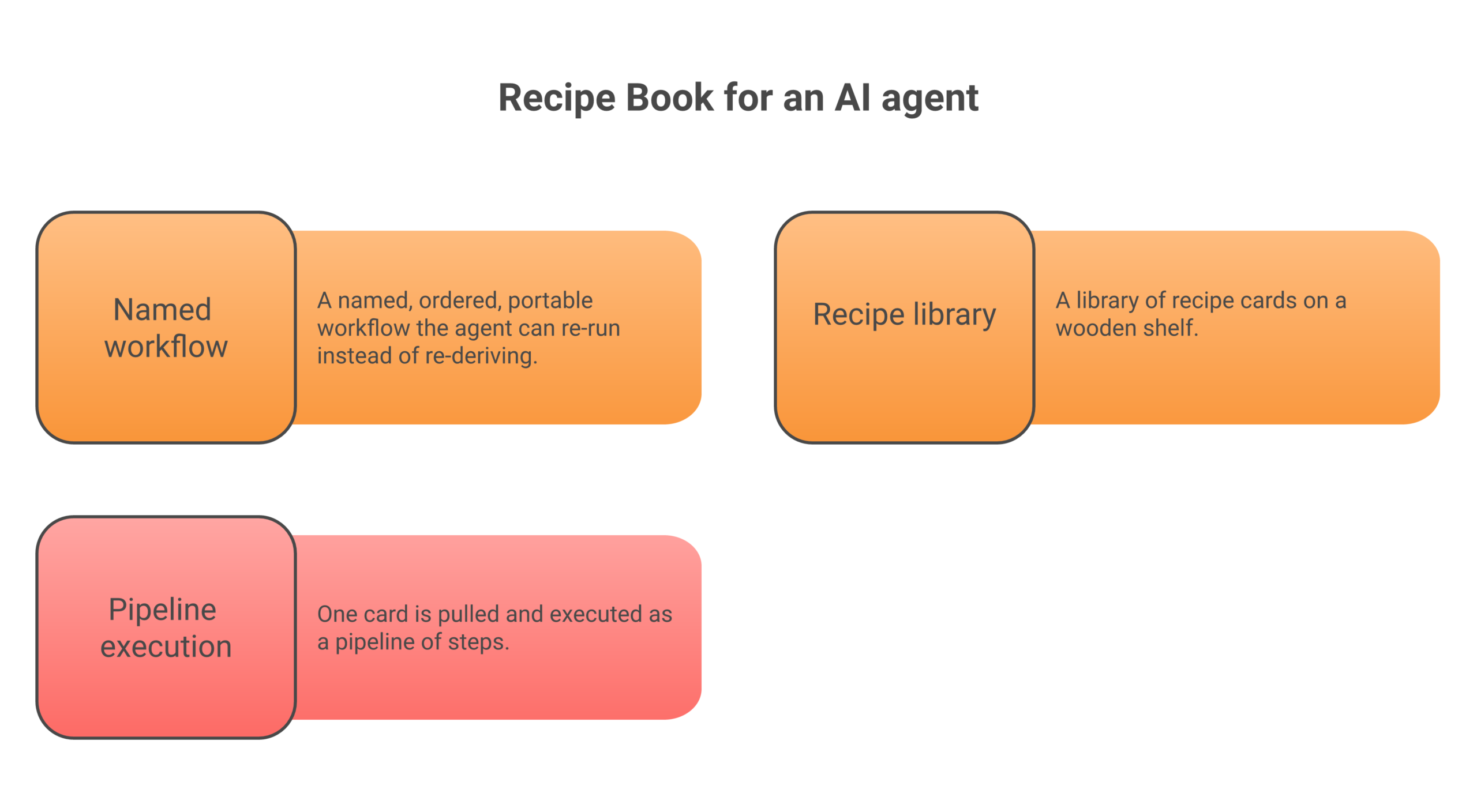

Smart agents forget how they did the smart thing. A recipe is the cure: a named, ordered, portable workflow the agent can re-run instead of re-deriving. TinkerClaw ships a whole Recipe Book — a browsable library of playbooks for writing papers, reviewing code, debugging, auditing, and orchestrating sub-agents. Part of our open Building Jarvis series.
What a recipe is
A recipe is a markdown file with numbered steps, constraints, safety notes, and a record of failures it has already overcome. It is the operational memory of “how we do this well” — extracted from a successful run so the next run starts from the lesson instead of the blank page. The agent reads the recipe, uses its steps as the skeleton of a plan, and fans the independent steps out to sub-agents.
What’s in the book
The catalog spans the work TinkerClaw actually does: writing (revise-paper, write-paper, brainstorm, write-plan), coding (code-review, debug, feature, refactor, plan, verify), and analysis (investigate, dependency-analysis). Each is a playbook, not a black box — you can open it, read the steps, and see exactly what the agent will do before it does it.
Why it matters
Most agent “memory” remembers facts. Recipes remember procedure — the harder and more valuable thing. They make an agent’s good behavior repeatable, auditable, and shareable, instead of a lucky one-off that evaporates when the context window clears.
The deeper version
Why a recipe is the right unit — neither a frozen script nor free-form prose, but the missing middle layer between them — is the subject of a full paper in this series: the recipe as the missing middle layer. The book is the practice; that paper is the theory.
TinkerClaw is open source. The whole architecture — brain-region anatomy, recipes, the effort allocator, the EEG — lives at github.com/globalcaos/tinkerclaw. This post is part of the open Building Jarvis series at The Tinker Zone.