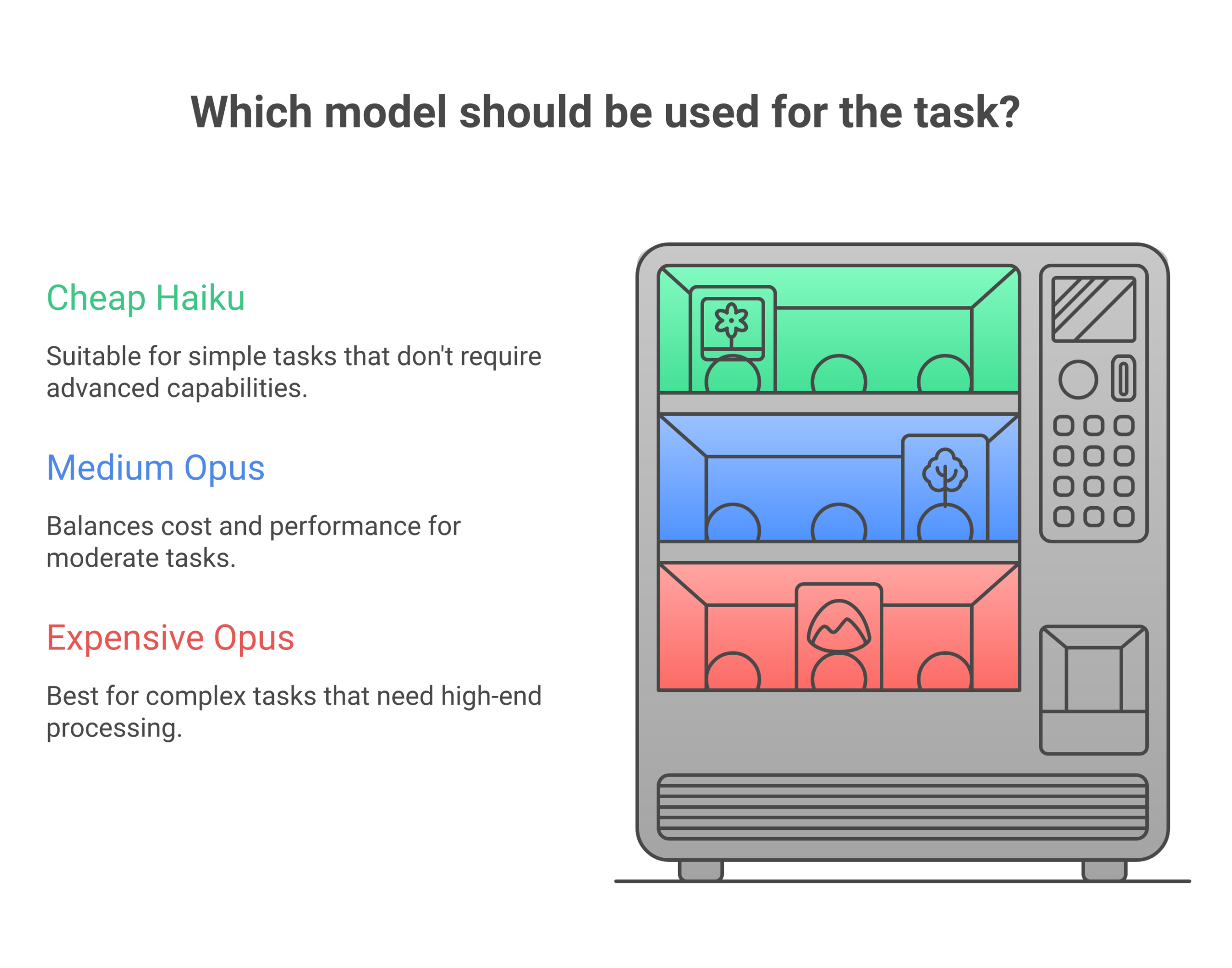

Stop sending “format this JSON” to your most expensive model. TinkerClaw’s effort × model slider lets you pick the right brain for every task — a cheap fast model for breadth, a frontier model for the genuinely hard reasoning — and an Auto mode that makes that call for you, per turn. Part of our open Building Jarvis series.
Two dials, not one
Model choice and effort are different questions. Model asks “can it do this at all?” — task difficulty. Effort asks “how much deliberation does this instance need?” — task depth. A simple lookup on a strong model is waste; a hard problem on a weak model is worse, because it burns tokens circling a wall it cannot climb. The slider exposes both dials per tab, so you set the floor and the ceiling independently.
Auto mode
Leave it on Auto and the allocator reads each turn and picks for you: breadth work drops to a fast cheap model, routine work sits in the middle, hard single-shot reasoning escalates. The rule it follows is the one that saves the most money — escalate the model before the effort. A fix that keeps failing does not need more thinking on the same model; it needs a stronger model. The allocator knows that, and the slider shows you what it decided.
Why it matters
Flat-rate-everything is how agent bills explode. The slider turns model spend into a deliberate choice instead of a default — and the Auto allocator makes the cheap-when-possible, strong-when-necessary call thousands of times a day so you don’t have to.
The deeper version
The theory of which work deserves which resources — a salience pyramid that ranks attention before it is spent — is a full paper in this series: the SALIENCE pyramid. The slider is where that theory becomes a control you can drag.
TinkerClaw is open source. The whole architecture — brain-region anatomy, recipes, the effort allocator, the EEG — lives at github.com/globalcaos/tinkerclaw. This post is part of the open Building Jarvis series at The Tinker Zone.