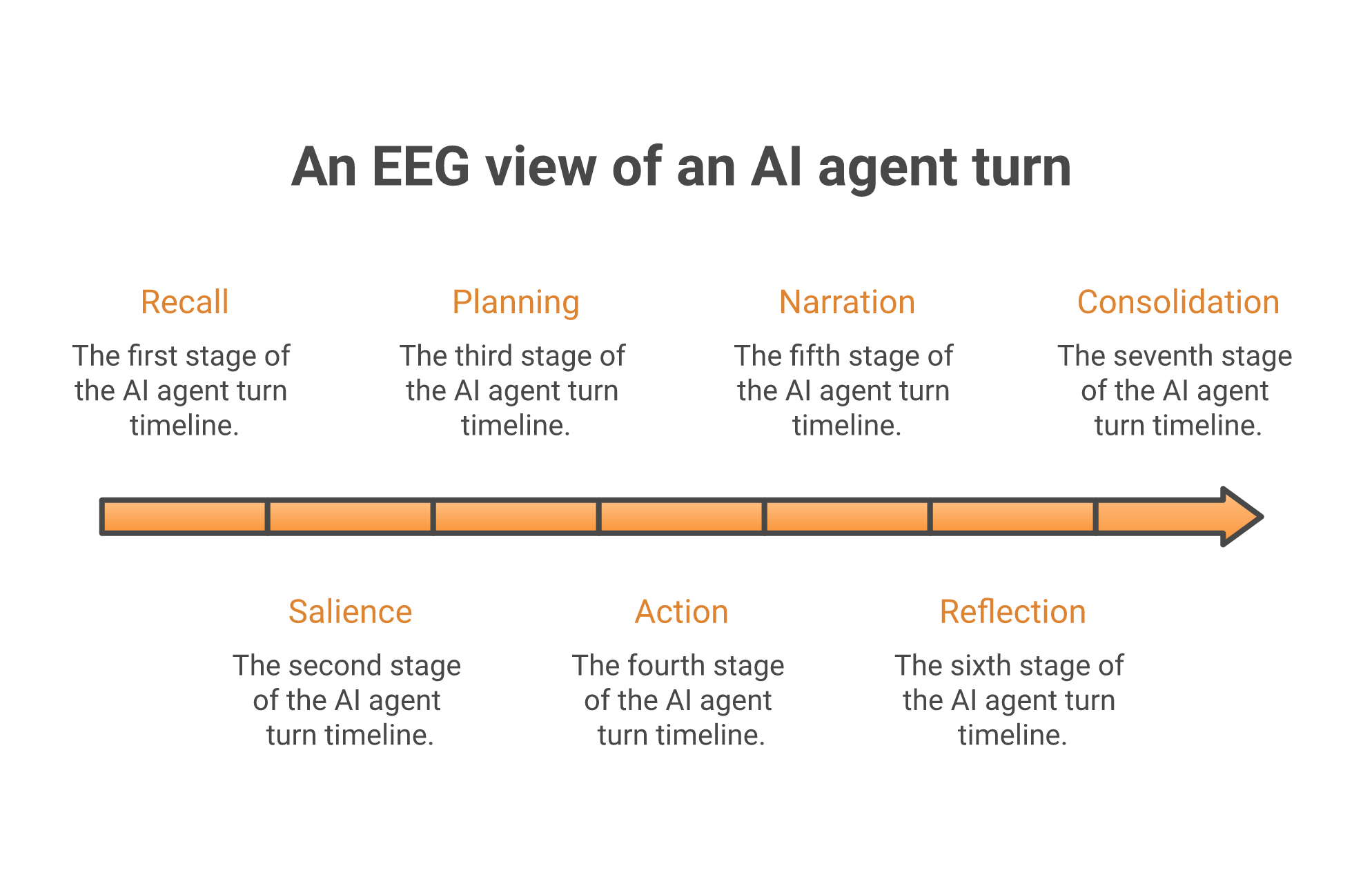
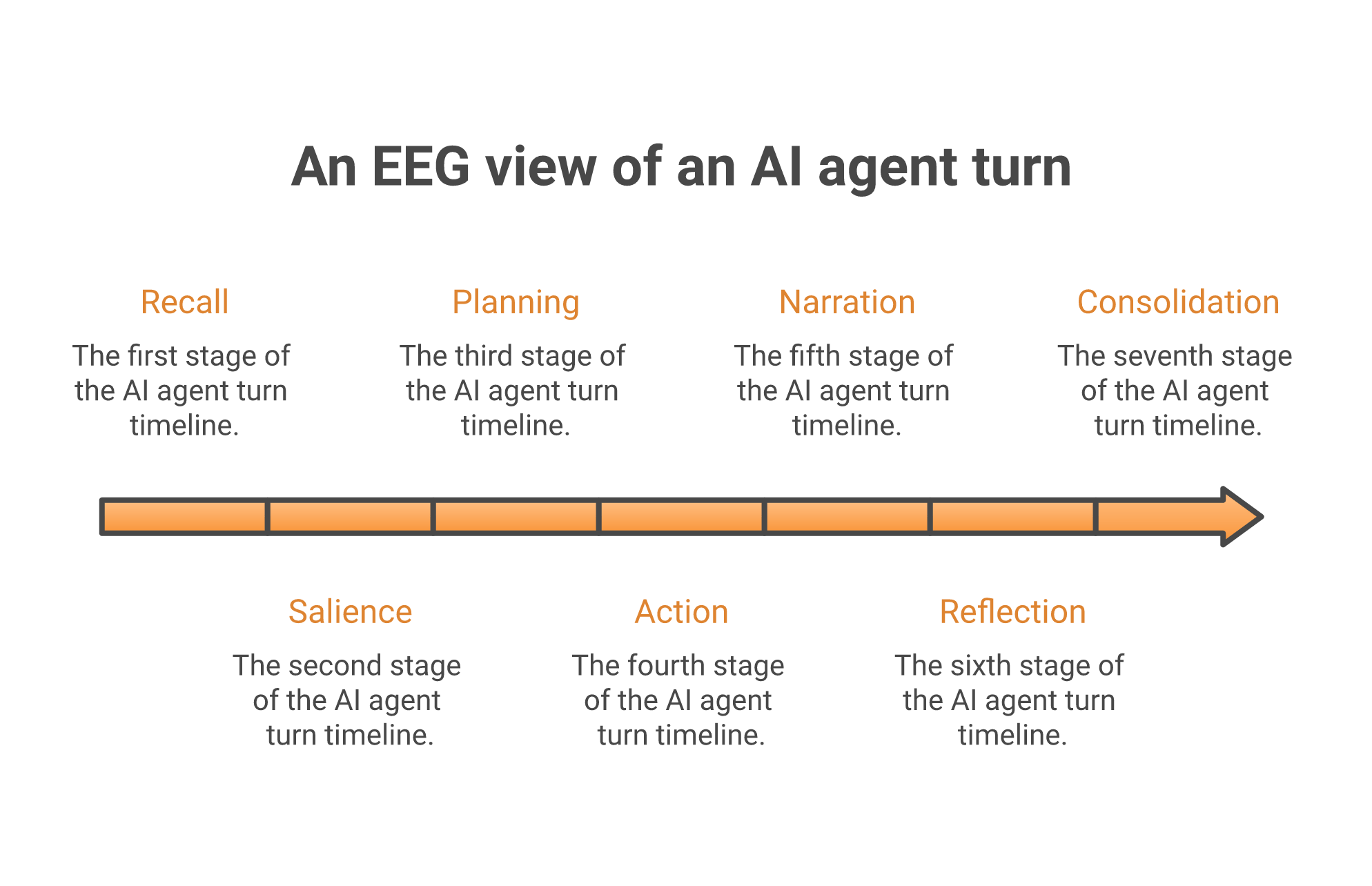
Most agents are black boxes. This one has an EEG. Every turn an agent takes passes through seven stages — recall, salience, planning, action, narration, reflection, consolidation. The EEG view in TinkerClaw draws that pass as a live trace, so you can watch the agent think instead of guessing what it did. Part of our open Building Jarvis series.
What it shows
The EEG is a side panel that paints one trace per turn. Each stop on the trace is a real stage in the agent’s cognitive pipeline — the same brain-region anatomy the rest of TinkerClaw is built on. Line thickness encodes the model that did the work (a thicker line means a heavier model was spent on that stop); the executed effort level is drawn honestly, with no decorative halo. When a turn is cheap, the trace is thin and short. When the agent reaches for a hard model at high effort, you see it.
There is a Session/All toggle: watch the current conversation, or watch every session the gateway is running at once. The second mode is the closest thing we have to a heartbeat monitor for a fleet of agents.
Why it exists
You cannot trust what you cannot see. An agent that says “done” has told you nothing about how it got there — whether it actually recalled the relevant memory, whether it spent a frontier model on a trivial format job, whether it reflected at all. The EEG makes the invisible legible. It is the difference between a teammate who reports results and a teammate whose work you can audit.
The deeper version
The stages the EEG draws are not decorative — each is a published piece of the architecture. The planning and effort-allocation stops are the Prefrontal and Salience systems; the salience scoring is the Amygdala; the closing reflection is Fractal reasoning; the off-turn write-back is Sleep Consolidation. The EEG is the dashboard; those papers are the engine room.
TinkerClaw is open source. The whole architecture — brain-region anatomy, recipes, the effort allocator, the EEG — lives at github.com/globalcaos/tinkerclaw. This post is part of the open Building Jarvis series at The Tinker Zone.