You forked a project that moves fast. The first sync took ten minutes. Three months later it takes a weekend, and one morning you find that a merge threw away a feature you wrote. Sound familiar?
The fork tax
A fork pays rent every week. Upstream ships, your branch drifts, and every sync is an argument over files you both changed. You can stop syncing and fall behind, or keep syncing and spend your best hours on someone else’s roadmap.
TinkerClaw paid that rent for months. In April 2026 one sync dropped our own compaction step for a while, and the last one, on 28 April, had to be cut into 23 staged merges before it went through.
Keep the engine, cut the cord
Think of a cook who leaves a famous kitchen. She keeps the knives and the techniques she learned there, writes her own menu, and still visits other kitchens to taste what they are doing.
TinkerClaw began as a fork of OpenClaw, and the engine is still theirs: the gateway, most of the model and channel plugins, the browser relay and the Android app all started in OpenClaw’s tree, under its MIT licence. What changed is the direction of flow: since that April sync, nothing has been merged in from OpenClaw. Our plugins still use OpenClaw’s plugin manifest, so the two stay close enough to share parts; how skills and channels plug in has the details.
A scout reads the field every night
Leaving the fork does not mean ignoring the field. A routine called fork scanner ships with the repo and runs at 05:15 each morning. It lists the forks of OpenClaw that are still moving and the new open-source agent projects of the last day or two, reads their source in a scratch clone, and writes the techniques worth adopting into a watchlist.
The scout only reads: it does not run their code or install their packages, and it removes its clones before it finishes. A merge rewrites your tree; the scout leaves it alone and hands a person a list. The setup script asks whether to turn it on, along with the other scheduled jobs.
Port the idea, credit the source
When an idea proves itself, someone rewrites it by hand on TinkerClaw’s own parts, and the code, the commit or the design notes name where it came from. Hand-porting costs more than a merge on the day, and much less every day after: nobody else’s refactor can break it, and nobody else’s roadmap sets its pace.
An idea that can rewrite your data arrives switched off. The memory reconciliation borrowed from Mem0 can update or delete stored facts, so it waits until you turn it on.
| What TinkerClaw uses | From | Licence |
|---|---|---|
| Gateway, model and channel plugins, browser relay, Android app | OpenClaw | MIT |
| Running tool calls that local models write as plain text | LocalClaw | MIT |
| The colours of the call-anatomy timeline | Mission Control | MIT |
| Live token tracking, as an idea | ClawMetry | MIT |
| The PDF viewer under the review tool | Mozilla pdf.js | Apache-2.0 |
| Facts that expire instead of being overwritten | Graphiti | Apache-2.0 |
| Memory that merges duplicate facts (off by default) | Mem0 | Apache-2.0 |
| A library of skills taken from successful runs | Voyager | MIT |
| Links between memories, followed one hop at recall | A-MEM | MIT |
| Trying several lines of thought before answering, on demand | Tree of Thoughts, LATS | MIT |
| Plans that resume after a crash | DeerFlow | MIT |
Every row has a commit and a file behind it: the full list is in CREDITS.md in the repo. Thank you to the OpenClaw maintainers and contributors, and to every project in this table. You did the hard part first.
What is TinkerClaw's own

The parts written here, from the first line:
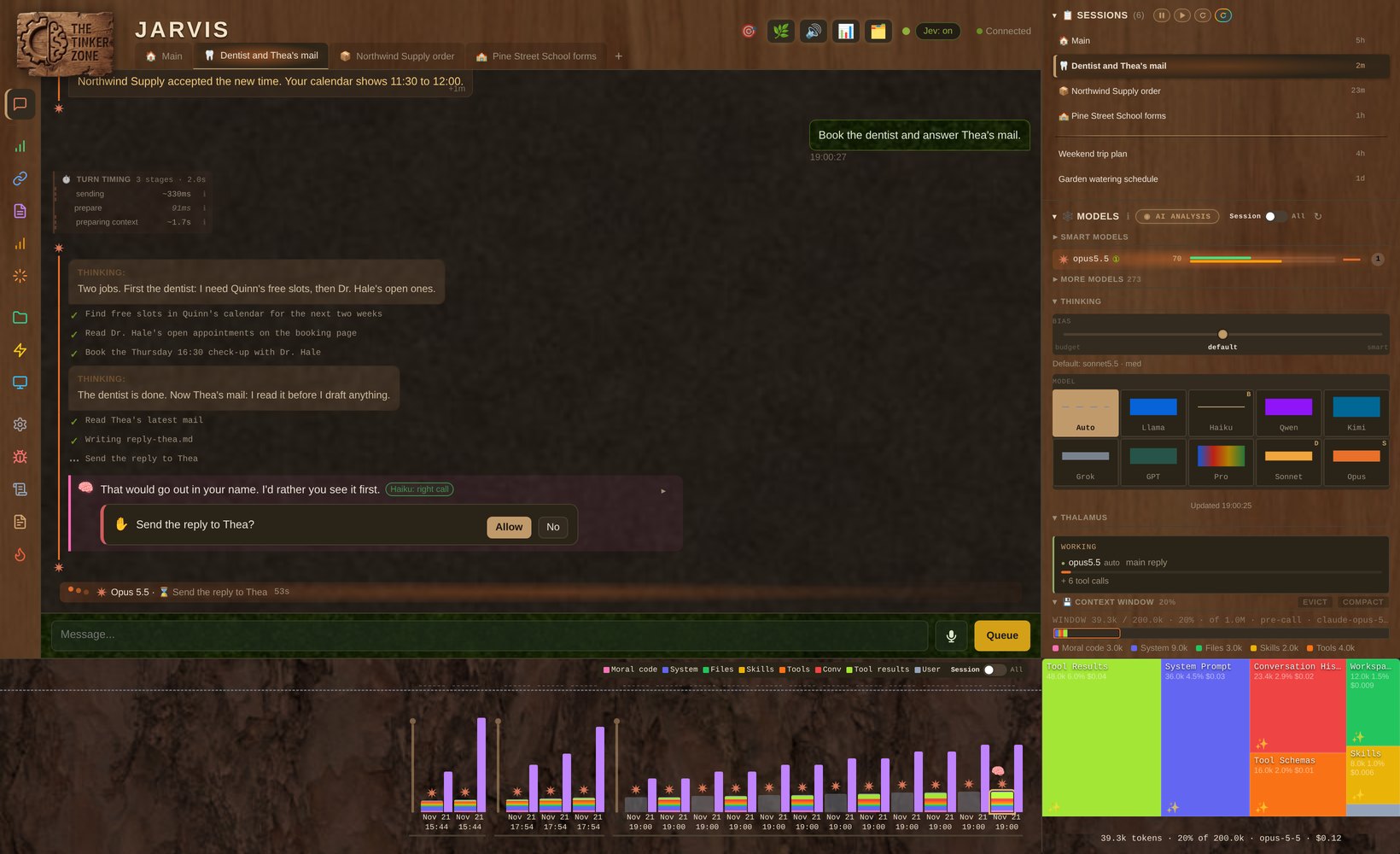
- The Tinker screen. The chat, with panels that show every call, its context and its cost.
- The amygdala guard. It stays quiet on routine steps and holds the one that looks wrong (how it learns to ask less).
- Thalamus. It routes each model call and scores which skills, recipes and plugins fit the task at hand.
- Prefrontal. Plans and recipes, so a long job follows its steps.
- Total Recall. Memory with pointer compaction and a consolidation pass while you sleep.
- ORCA. File leases, so several agents can edit one working tree without stepping on each other.
- The moral code. The same ethical rules, delivered to every model in every conversation.
- The review layer on top of pdf.js. Highlights and notes the agent applies, and a voice that reads the document aloud.
Baked into TinkerClaw
All of this is baked into TinkerClaw. I tinker with ideas like these all the time, mine and other people’s, and they go into the code the moment I get wind of a good one or need something extra in my day to day.
That is also why the fork had to end. When writing code gets cheap, owning your direction is worth more than any single feature, a shift I described in from block to blob. Respect to OpenClaw, where it all started.
For builders
- Memory Hooks (MNEMOSYNE) (PDF): four hooks that upgrade an agent’s memory without forking its core; the expiring facts and the reconciliation in the table are its upgrades. Behind Port the idea, credit the source.
- Sleep Consolidation (CEREBELLUM) (PDF): a loop that runs at night and makes a stateless agent improve over time; the skill library in the table feeds it. Behind Port the idea, credit the source.
There are more papers on memory, guards, planning and cost: see the brain map and the site map.
Leave a Reply