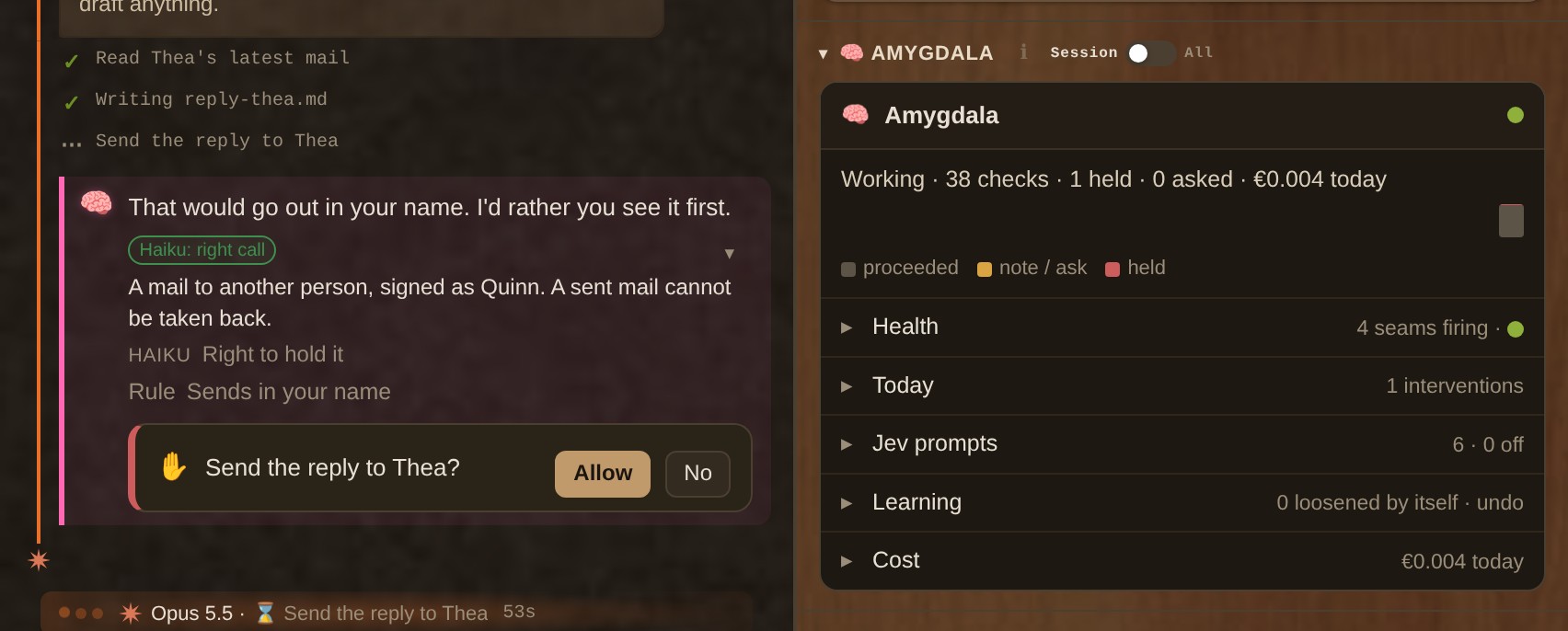

Allow this command? You click Allow, and the next one, and the one after. By mid-afternoon you press Enter before the dialog has finished drawing. Then one of those prompts is the agent wiping a folder you still needed, or mailing a half-done draft to every parent at Pine Street School, and it went through with your own click on it.
Anyone who has run a coding agent for a week knows the two ways out, and both lose. Keep the prompts, and they train you to stop reading, so the one alarm that matters arrives already dismissed. Turn them off with the skip-permissions flag, and nothing is watching at all. A guard that asks about everything protects you about as well as no guard, and it takes your attention every few minutes on top.
What you want is a guard that knows which steps deserve your eyes, and gets better at telling them apart. Your own amygdala works this way. It ignores the hum of the fridge, fires at the wet step at the top of the stairs, and in a new house it soon learns which creaks are harmless. In an agent the noises are its steps, firing means interrupting someone, and learning means tuning. We call the software version a digital amygdala.
Two questions decide whether you hear anything
Before a step that changes something, the guard asks two things. How hard is this to undo, from read-only up to irreversible or reaching other people? And how sure is the agent about what you meant? A step that is easy to undo and clearly asked for goes ahead in silence.
Say Quinn asks Jarvis to tidy up a project. Listing the folder goes ahead, and so does deleting the build folder Jarvis made ten minutes earlier, because the guard knows which files are the agent’s own work from this session. Sending the quote to Northwind Supply without saving a draft first asks Quinn. A recursive delete of one of Quinn’s own folders is held until Jarvis shows proof it was asked for.
A quiet word to the agent comes before a question to you
A yes-or-no gate has one tool, and it is the loud one. This guard has five, and three of them never reach you. A note adds one line to the agent’s context, such as the reading of your request it assumed. A demand for proof stops the step and names the evidence that would release it. A send-back returns a reply to the agent to be finished. Only then come the two you see: a question, and a hold, where the step waits for your button and runs nothing if you never press it.

The judge never picks among them. A small hosted model, Jev, answers short typed questions with fixed choices (“how hard is this to undo: 0, 1, 2 or 3?”), and plain code turns the answers into a response. That split makes the guard testable. Every question carries cases it must flag and cases it must leave alone, and every change to a question is replayed against them before it applies.
A rule earns the right to act
Out of the box the guard runs in shadow mode: it decides, it logs, and it touches nothing. After each turn a second model reads what the agent did next and judges each flag: useful, noise, or harmful.
A note or a send-back starts acting on its own only when its record over the last two weeks clears a bar (enough reviews, at least half of them useful, few harmful), and it stops the moment the record drops. This is counted rule by rule, so one noisy rule never drags a useful neighbour down with it. Holds and questions to you never start acting this way: anything that stops your work stays your decision.
Quick to tighten, slow to loosen
The tuning runs both ways, at different speeds. When you mark a step the guard should have caught, the cut-off for that kind of step tightens at once. One incident marked “should have held” becomes a precedent straight away, with no statistics, and a harmless look-alike cancels it. A kind of step that keeps raising false alarms earns a proposal to loosen, and that proposal waits for you as a card. By default, only you loosen a rule.
Under all of it sit the hard rules, such as a recursive delete of an absolute path. They are plain code, they run before the judge is asked, they keep working when the judge is offline, and the learning loop never proposes changes to them. However quiet the guard gets, that floor stays where it is.
Over four weeks of that tuning on our own install, the share of steps where the guard stepped in fell from about one in twenty to about one in three hundred, and the reviewer found fewer missed steps, not more.
All of this is baked into TinkerClaw
The guard is the amygdala plugin in TinkerClaw, which grew out of OpenClaw. It loads by default and stays dormant until you give it a Jev token. Then it starts in shadow mode, so you can read what it would have done before you let it act. Your real steps stay on your machine unless you turn sending on, and even then only the fields each question reads leave, redacted. Next in line: when a short follow-up points at something the chat never had, like a dictated word that came out as another, the agent looks for what was meant and asks when nothing shows it.
I tinker with ideas like these all the time, and the moment I get wind of a better trick, or need something extra in my day to day, I bake it into the code. If you want to see where that habit leads, I wrote about it in from block to blob.
For builders
- Learned Intuition (PDF): the digital amygdala in full, with its typed questions, its proof table and its learning loop; it is the paper behind Two questions decide whether you hear anything and A rule earns the right to act.
- AEGIS (PDF): the layered security framework the hard rules come from; it is the floor in Quick to tighten, slow to loosen.
There are more papers behind TinkerClaw, on memory, models and how the agent plans. You can find them by topic on the brain map and the site map.
Leave a Reply