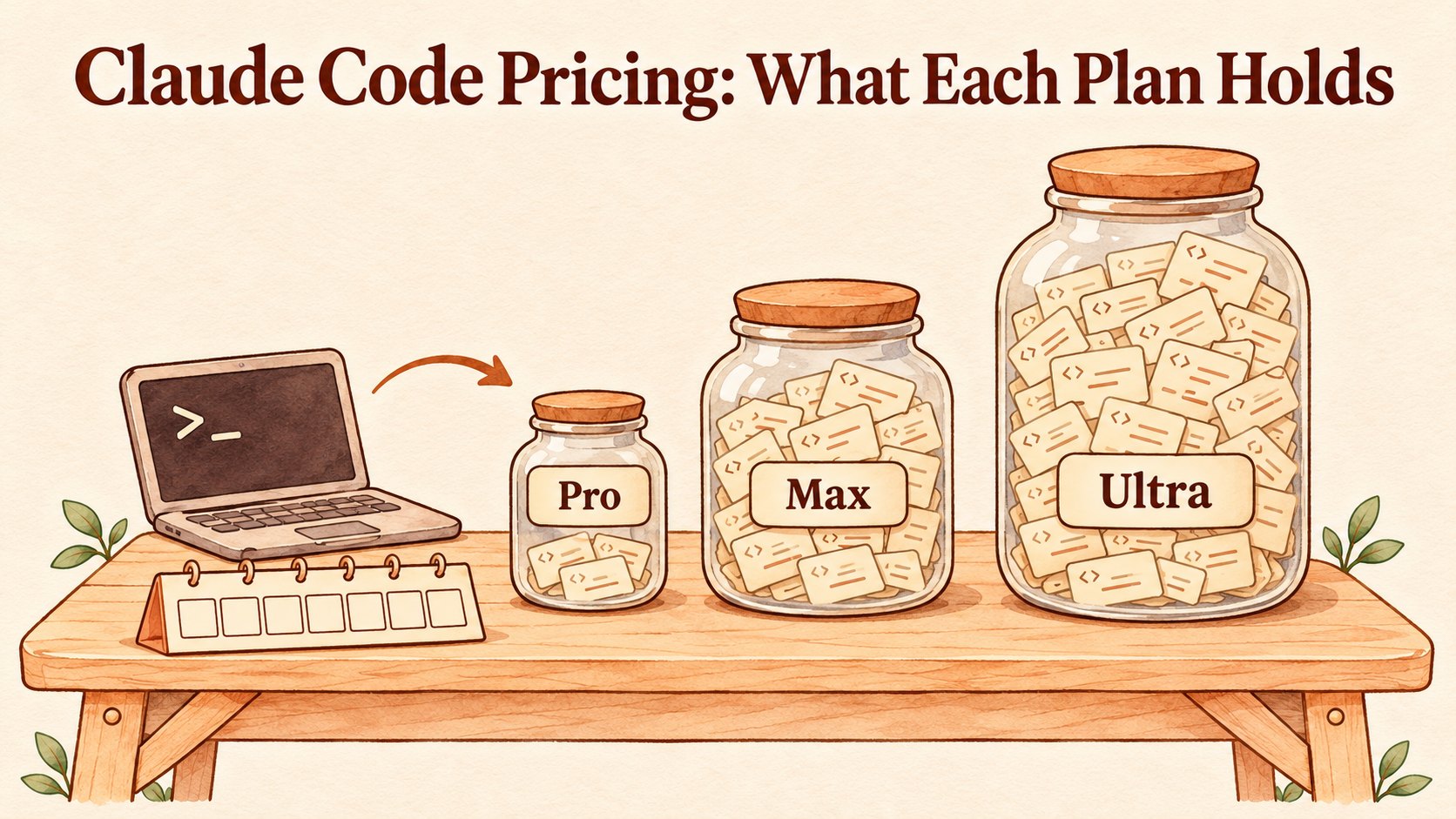

Claude Code comes with every paid Claude plan: Pro at $20 a month, Max at $100 and Ultra at $200. Ultra is the plan that used to be called Max 20x. The price list is the easy part. What a pricing page won’t tell you is how much work a week of each plan holds, so we measured it on our own top-tier seats.
One week of Ultra held between $1,077 and $2,169 of Claude at API list prices, depending on the model mix. Using Anthropic’s own multiples, that puts a Pro week at about $108 to $217 of work and a Max week at about $538 to $1,084. In tasks: a typical ten-minute agent job cost $5.91 at list, so Pro holds roughly 18 to 37 of them a week, Max 91 to 184.
Claude Code plans and prices in November 2026
| Plan | Price | Weekly usage | Five-hour limit |
|---|---|---|---|
| Free | $0 | Limited | Limited; no Claude Code |
| Pro | $20 a month, or $17 a month billed yearly ($200 up front) | 1× | Yes |
| Max | $100 a month | 5× Pro | Yes, 5× Pro |
| Ultra | $200 a month | 10× Pro | None, once Anthropic clears the account |
Prices from claude.com/pricing and Anthropic’s help pages, 22 November 2026, before tax.
Three details most price guides miss. Max 20x is gone: Anthropic renamed it Ultra and moved existing subscribers at the same price. Ultra drops the five-hour limit once Anthropic has cleared the account, and the five-hour meter on our two seats read 0% in all 879 readings, even on the day a whole week burned in 15 hours. And Max and Ultra now come with monthly API credits, $100 and $200, for building on the Claude Platform.
Every plan shares one budget between the Claude apps and Claude Code. A long chat in the browser and a refactor in the terminal draw from the same weekly meter.
Why "5× Pro" doesn't tell you how much work you get
Anthropic publishes multiples and never the size of the base, so “5× Pro” is a promise relative to a number nobody has seen. The guides that rank for this search repeat the multiples and then guess at message counts.
So we ran it the other way round. Our seats are two Ultra accounts that run Claude Code day and night: an always-on agent, interactive sessions in the terminal, and batches of unattended agent jobs. Claude Code logs the tokens of every response, and the plan’s usage meter reports what share of the week is gone. Price the tokens at Anthropic’s API list, divide by the percentage the meter moved, and you get what one percent of a week is worth. Multiply by a hundred and you have the size of the week.

What a week of Ultra actually held
We measured three windows, each on a seat that nothing else was using at the time:
- A normal working week. After the reset, by Friday morning, the meter stood at 90%. In that time Claude Code sent 14,540 responses across 649 sessions, 91% of them on Opus 5.5. Priced at list, $1,952, which is $21.69 per percent and $2,169 for the full week.
- Agent jobs, mostly on Opus 5.5. Unattended coding jobs, about three at a time, moved the meter 9 points in three and a half hours for $135 of list-price work: $14.96 per percent.
- Agent jobs heavy on Fable 5.2. The same kind of batch with Anthropic’s top model moved it 39 points in six and a half hours for $420: $10.77 per percent.
The spread is the answer to “how much is 5× worth”. The meter is not a dollar counter. Cheap tokens, mostly cache reads on Opus, buy more of the week; Fable fills it faster for each dollar it would cost on the API. Fable also has its own ceiling on Max and Ultra: up to half the weekly limit.
That puts the Ultra week at $1,077 to $2,169 of API-priced work. Pro is a tenth of that week and Max half, by Anthropic’s multiples. We did not run a Pro or Max seat, so those two lines are derived, not measured.
When the limits run out
A week lasts as long as your pace allows. We measured two paces:
- Daily pace. Our always-on agent plus interactive work used 0.78% of an Ultra week per hour. At that rate Ultra lasts 5.4 days, so even the top plan runs out before its seven-day reset; we keep a second seat for that reason. Max would last 2.7 days and Pro about 13 hours.
- Burst pace. About three agent jobs at once used 6% of an Ultra week per hour. A whole Ultra week went from 0 to 100% in 15 hours. Max would last about 8 hours and Pro under 2.
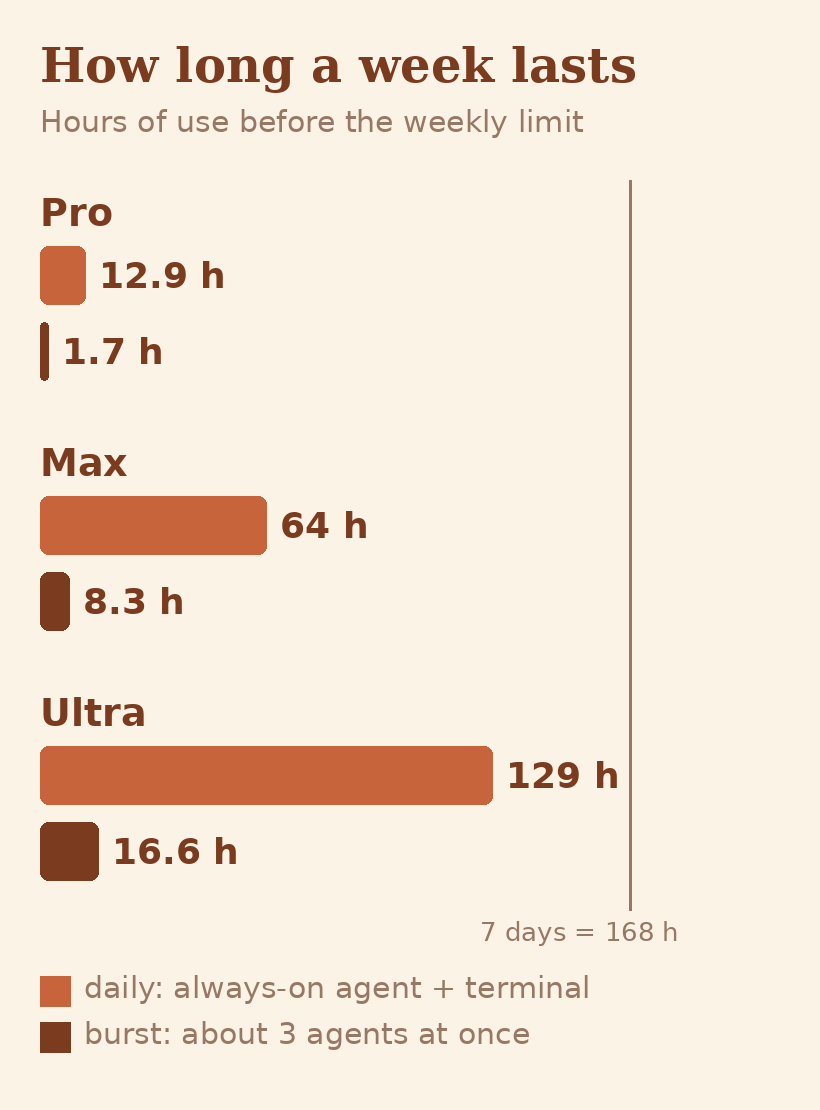
The five-hour limit is the one Pro and Max users hit first in a burst. Anthropic does not publish its size and we have no Pro seat to measure it on. One thing follows from the burst figure anyway: three parallel agents use 60% of a whole Pro week every hour, and the five-hour window is only a slice of that week, so on Pro it runs out before the 1.7 hours the whole week would last.
Which tasks burn the week
Three things explain almost all of it, and none of them is how much you type.
- Long sessions. Sessions whose context grew past 400,000 tokens were 13% of the sessions and 60% of the week’s value. Each response in them cost 1.6 times as much as in a short session, because every response re-reads the whole context.
- Re-reading context. 97% of all tokens were cache reads. Priced at list, re-reading and writing the cached context made up 80% of the week’s value; the code and text the model wrote were 20%.
- The top model. A typical Fable 5.2 job took 40 minutes and $35.69 at list; a typical Opus 5.5 job took 9 minutes and $4.99.
So the cheapest habit is starting a fresh session for a new job. Running /compact before a session crosses a few hundred thousand tokens comes next, and Fable is worth saving for the problems Opus gets wrong.
Pro, Max or Ultra: three profiles
The task here is our median unattended agent job: about ten minutes, 29 tool turns, $5.91 at list.
- Hobbyist: Pro. A few evenings a week, a handful of tasks each time. Pro holds 18 to 37 of those tasks a week, and the five-hour limit is the wall you will meet. Pro pays for itself against an API key at about four tasks a month.
- Daily developer: Max. Ten tasks a day, five days a week, is 50 tasks, about $300 at list. That empties a Pro week in two to four days and fits inside a Max week (91 to 184 tasks) with room for a long debugging session.
- Agents around the clock: Ultra, and plan for more. An agent that works while you sleep runs at our daily pace or faster. That used 90% of an Ultra week in under five days, about $400 a day at list. No API key comes close at that volume; the question is whether you need a second seat or a cheaper model for the side work.
Our 30-day OpenClaw bill shows the same arithmetic for a whole agent setup, with the flat plans next to the pay-per-token lines.
How to measure your own week
1. Read the meter. In Claude Code type /usage (it shows session cost and plan usage), or open Settings → Usage on claude.ai. Note the weekly percentage and the time.
2. Work as usual for a day. Read the meter again. The difference is your daily share of the week.
3. Scale. If a day uses more than 14% of Pro, Pro will not last the week. Max gives you five times the room, Ultra ten.
4. See what eats it. The same /usage screen lists what is contributing to your limits. If one long session dominates, split the work into fresh sessions before you pay for a bigger plan.
FAQ
How much does Claude Code cost?
Claude Code itself is free to install; you pay through a Claude plan or an API key. Pro is $20 a month, Max $100 and Ultra $200. On the API you pay per token: Opus 5.5 lists at $4 per million input tokens and $20 per million output.
Is Claude Code included in Claude Pro?
Yes. Pro includes Claude Code in the terminal and in IDEs such as VS Code and JetBrains, and it shares the same usage limits as the Claude apps. The Free plan does not include it.
What happened to Claude Max 20x?
Anthropic renamed it Ultra, and existing Max 20x subscribers moved over automatically at the same $200. Ultra gives ten times Pro’s usage per week and, once Anthropic has cleared the account, no five-hour limit.
Is the API cheaper than a subscription for Claude Code?
For light use only. A typical ten-minute agent task cost us $5.91 at list, so a $20 Pro plan pays for itself at about four tasks a month. A full-time agent used about $400 a day of list-price tokens on a $200 plan.
What happens when I hit the Claude Code usage limit?
New requests stop until the limit resets; a step already in progress may finish first. You can wait, or continue on API credits if you have set them up. The weekly meter resets at a fixed time assigned to your account.
The meter on screen, in TinkerClaw
We could only measure this because our agent runs on TinkerClaw, which keeps the meters in view while it works. Its budget panel asks each provider for its own usage or remaining quota, and a trace grows a segment per model call, thicker the more that call cost. See under the hood walks through both panels. Its Auto setting picks a model per task, so a greeting does not spend Opus time; the post on Auto explains how it chooses. You can click through all of it in the live demo.
The same tools come as skills on ClawHub: the Token Panel for every provider’s spend and the Model Router, which sends work to flat-rate models first. If you are weighing a subscription against your own hardware, AI costs in 2026 runs that comparison. For the same question on OpenAI’s side, ChatGPT Plus price: is $20 a month worth it? measures what the Plus meter holds.
For builders
- Budget Prompting (PDF): why every response re-bills the whole context and the techniques that cut it; the paper behind Which tasks burn the week.
- There are others, by topic, in the brain map and the site map.
Leave a Reply