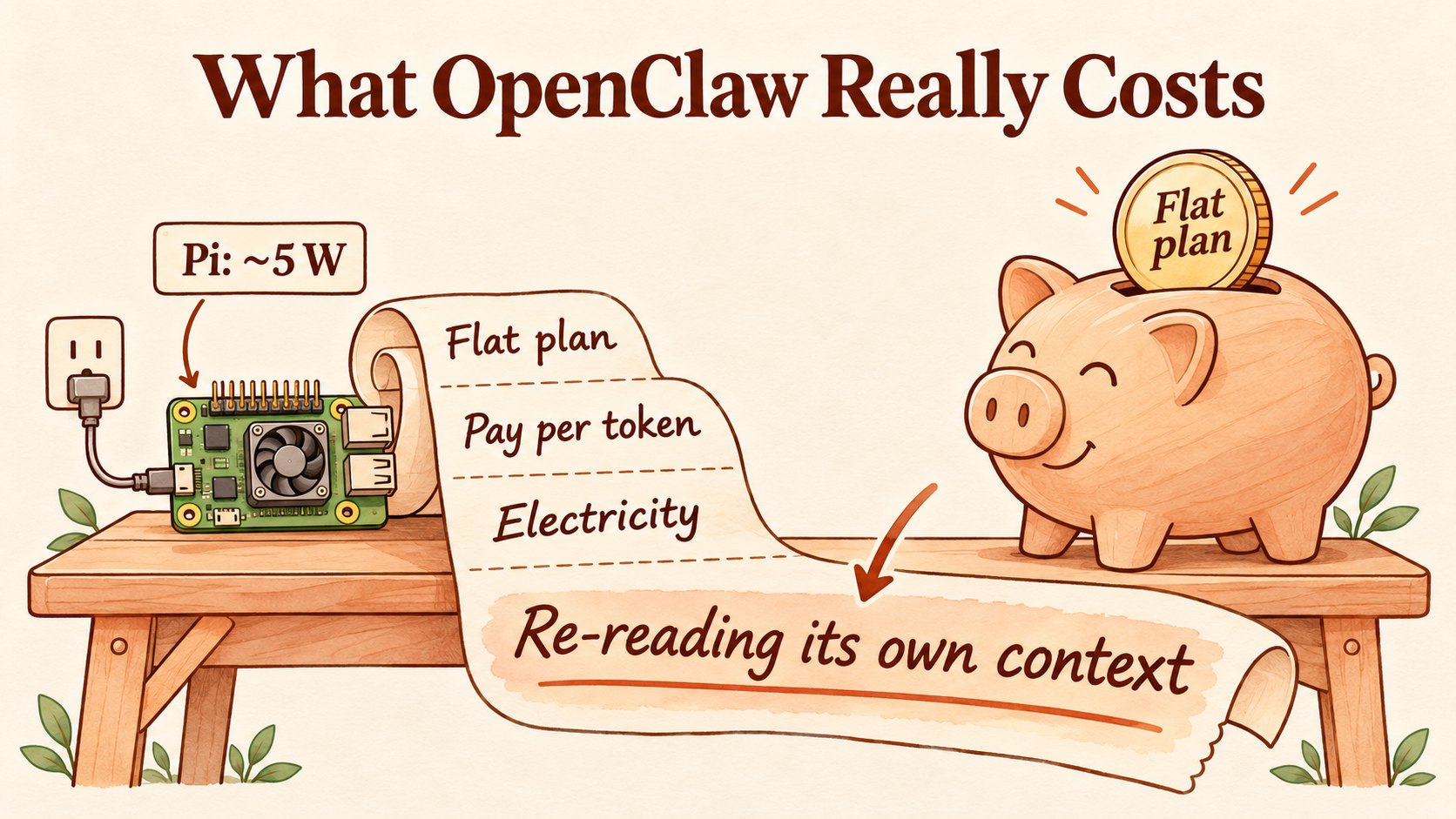

How much does OpenClaw cost per month? Ours ran around the clock for 30 days and pushed 13.8 billion tokens through its models. At API list prices the Claude share alone comes to $5,305. What it cost in money: two flat Claude seats (at most $400 at today’s top-tier price), ChatGPT Plus at $20, $18 of pay-per-token calls, and about a dollar of electricity for the Raspberry Pi 5 it lives on.
So the answer is a spread: about $20 a month for light use on one flat plan, a few hundred for an agent that works all day, and thousands if you send that same all-day agent through an API key. The rest of this post shows where the money goes, which settings move it, and how to work out your own number in ten minutes.
Every other guide gives an estimate
The pages that rank for this question are written by hosting companies and lookalike sites, and they all say the same thing: the software is free, a server is cheap, and the model bill “depends on usage”. That is true and it does not help you budget. Nobody can tell from it whether their own agent will cost $10 or $1,000.
The range is so wide because of one mechanism nobody puts in the headline: an agent pays to re-read its own context on every call, which we call the re-read bill. Once you see its size, the choice between a subscription and an API key makes itself.
The bill, line by line

The window is 24 October to 22 November 2026, read from the gateway’s own usage log. Every line below is measured on our install; the plan prices are the providers’ list prices on the day this was written.
- Claude, through flat plans. 93% of all tokens went to Claude models through the Claude CLI on two subscription seats. The gateway records those tokens but no price, because the plan pays for them. Priced at Anthropic’s API list, they come to $5,305 for the month, or about $177 a day.
- Grok, through a flat plan. A second engine for side work. 5,845 calls whose tokens would have cost $383 at list price.
- ChatGPT Plus. $20 a month. It runs reviews and second opinions; its meter for the week sat at 21% used when this was written.
- Pay per token. The only lines that bill by the call: Gemini ($13.56) and Kimi K3 on DeepInfra ($4.67). $18.23 for the month, or 61 cents a day.
- The server. A Raspberry Pi 5 with 16 GB of RAM running the gateway, chat and scheduled jobs. The models run in the cloud; the Pi runs the gateway and the agent processes around them.
- Electricity. The Pi’s power chip reported between 4.2 and 5.4 W across six readings with the load average at 7, so call it 5 W. That is 3.5 kWh a month: $0.53 at $0.15/kWh, $1.24 at $0.35/kWh. Those readings cover the board’s rails, not the wall socket; double them for the power supply, SSD and fan and it is still under $3. The plans are the bill, and the box rounds to zero.
Where the money goes: the re-read bill

An agent does not send your message to the model. It sends your message plus everything before it: the system prompt, the tool definitions, the files it loaded, every tool result so far. Then it does that again for the next call in the chain, and the next. The provider’s prompt cache makes the repeated part cheaper, but cheaper is not free.
On our install, 97% of all tokens were cache reads. Priced at list, 80% of the Claude bill would have been cache traffic: 47% re-reading the cached prompt and 34% writing it into the cache. The text the model wrote was 20%. Fresh input, the words you type, was under a tenth of a percent.
One turn of ours, a request that runs a chain of tool calls, re-read about 4.2 million cached tokens on Opus 5.5. At list that turn costs $1.68. Twenty of those a day is $34. That is why a busy agent on an API key surprises people: they think about what they type, and they pay for what the agent re-reads.
Cache writes are the expensive half of the mechanism. On Opus 5.5 a cache write lists at $5 per million tokens and a cache read at $0.20, so writing costs 25 times more. A chat that sits idle past the cache window and then resumes pays to write the whole prompt again.
The settings that cut it most
In order of how much they moved our bill:
- Put the volume on a flat plan. This is the whole difference between $5,305 and a few hundred. OpenClaw can run Claude through the Claude CLI on a subscription, and its docs note that Anthropic confirmed in July 2026 that CLI reuse is a sanctioned pattern; read the current terms before you rely on it. The same goes for ChatGPT plans through the Codex route.
- Keep the context short. Everything in the prompt is re-read on every call. Set
agents.defaults.contextPruning.modeto"cache-ttl"so old tool results get trimmed, drop files the agent does not need at start-up, and start a fresh chat for a new job instead of piling it onto a long one. - Keep the cache warm or let the chat go. A long chat resumed after a coffee break rewrites its cache. Finish the job in one sitting, or start clean.
- Send scheduled jobs to a cheap model. Each automation job (what used to be the heartbeat) carries its own model setting. Our Kimi K3 calls cost 8 cents each, against $1.68 for an Opus turn at list. A job that runs every 30 minutes adds up to 1,440 calls a month, so its model matters more than any single chat.
- Watch the meter.
/usage fulladds the tokens and the estimated cost to every reply,openclaw status --usageshows how much of each plan’s window is left, and Control UI → Usage breaks the month down by provider and model.
When a flat subscription beats paying per token
The rule is plain arithmetic: price a month of your agent’s tokens at list, and compare it with the plan. If the list price is higher, subscribe.
For an always-on agent the answer is not close. At our rate, a $200 Claude plan pays for itself in about 27 hours. Twelve turns the size of ours cost $20 a day at list, which is a $20 plan’s whole month.
Pay per token wins in three cases:
- Light or bursty use. A few short jobs a day never reach a plan price.
- Jobs that must never stop. Flat plans have five-hour and weekly windows. One of our two seats was at 97% of its week when this was written; an API key has rate limits but no weekly cap.
- Cheap models for side work. Open-weight models on a pay-per-token host cost cents, and a plan does not cover them anyway.
Most setups end up mixed, like ours: one or two flat plans for the heavy lifting, a pay-per-token key for scheduled jobs and fallbacks.
Work out your own number
1. Count a month of tokens. In the Control UI open Usage and pick 30 days, or run openclaw gateway call usage.cost --params '{"days":30}' --json. Note input, output, cache reads and cache writes separately.
2. Price them at list. Multiply each kind by your model’s list price per million. For Claude, Anthropic’s pricing page has all four columns. Your total is what an API key would charge.
3. Compare. If that number is above a plan’s price, the plan is cheaper. If it is below, pay per token and set a spending cap with the provider.
4. Add the box. A Raspberry Pi 5 costs about a dollar a month in power. A rented VPS costs whatever its price tag says; the agent does not need a big one when the models run in the cloud.
If you have no history yet, start on a $20 plan, run it for a week with /usage full on, and do the sum on real numbers.
FAQ
Is OpenClaw free?
The software is free and open source. You pay for the models it calls, through a subscription or an API key, and for the machine it runs on.
How much does OpenClaw cost per day?
On our install, 61 cents a day of pay-per-token calls on top of the flat plans. The same traffic would have cost about $177 a day through a Claude API key at list price.
Why is my OpenClaw API bill so high?
In our experience it is the re-read bill: long chats, big tool outputs and files loaded at start-up, all sent again on every call. The cache-read and cache-write columns of the usage view show it.
Can I use my Claude subscription with OpenClaw?
Yes, through the Claude CLI backend. OpenClaw’s own docs record that Anthropic called CLI reuse sanctioned in July 2026 and advise checking the current terms before relying on it.
Is a Raspberry Pi enough to run OpenClaw 24/7?
For the gateway, yes: ours runs on a Pi 5 with 16 GB. The Pi is not running the models; those are in the cloud. Running models locally is a different budget, covered in our cost comparison linked below.
The bill on screen, in TinkerClaw
All of the numbers above came out of the gateway’s usage log, and in TinkerClaw they are on screen while the agent works: a budget panel that reads each provider’s own meter, and a trace that grows a segment per model call, thicker the more it cost. See under the hood walks through those panels, and the live demo lets you click through them.
The same idea is packed as two skills on ClawHub: the Token Panel, which tracks every provider’s spend, and the Model Router, which sends work to flat-rate models first and to metered ones only when it pays. If you are weighing hardware against renting and subscriptions, AI costs in 2026 runs that comparison, and what running an AI agent 24/7 costs is the snapshot from March. For what a Claude plan holds in a week of Claude Code, see Claude Code pricing: how much work Pro, Max and Ultra really hold. And for ChatGPT’s plan, see ChatGPT Plus price: what a heavy week uses.
For builders
- Budget Prompting (PDF): why every turn re-bills the whole context and the techniques that cut it; the paper behind Where the money goes: the re-read bill.
- Total Recall (PDF): what stays in the context and what gets folded away without losing it; the paper behind The settings that cut it most.
- There are others, by topic, in the brain map and the site map.
Leave a Reply