
Which AI is best for coding? For most work in late 2026, it is the strongest model you can afford to run on every change. In our own code repositories, Claude Opus 5.5 handled 97% of the coding agent’s model calls over the last two months. The leaderboards cannot pick for you, because the top three models sit within a few points of each other. A better question decides it: how big a mistake can you afford on this change?
- Cheap to undo (boilerplate, a rename, a log summary): a small, fast model.
- Caught by your tests (a feature, a bug fix): the strongest everyday model you have.
- Expensive or irreversible (a migration, auth, deleting data): the strongest model at high effort, a plan first, and a reviewer from another company.
The rest of this post is the data behind that rule, from months of routing coding work across Claude, GPT, Gemini and Grok, and the one lesson that changed how we read our own logs.
Why leaderboards don't settle "best AI for coding"
The pages that rank for this search are leaderboards and tool lists, and they disagree with each other. On 22 November 2026, llm-stats put Claude Fable 5.2 first (49.9), then Claude Opus 5.5 (47.5) and GPT-6.2 Astra (47.4). BenchLM put Gemini 4 Neon first (92.9), then Fable 5.2 (92.4) and GPT-6.2 Astra (91.9). Two good leaderboards, two different winners, and one point between first and third on one of them.
A one-point gap on SWE-bench-style tasks will not show up in your week. Those benchmarks score isolated problems that either pass a test suite or not. Your week is made of other costs: the time you spend reading a diff, the patch that passed the tests and broke something the tests did not cover, the agent that went the wrong way for twenty minutes before you noticed. Those costs depend far more on the kind of change than on which of the top three models made it.
Where our coding work actually went
We keep two logs that answer this. Claude Code is where nearly all our coding happens (the Codex CLI opened five sessions in our repos over the same two months), and it writes a transcript of every API call, with the model that answered. Our parallel coding tool, which splits a job into units and works on them side by side, logs which model it planned to give each unit.
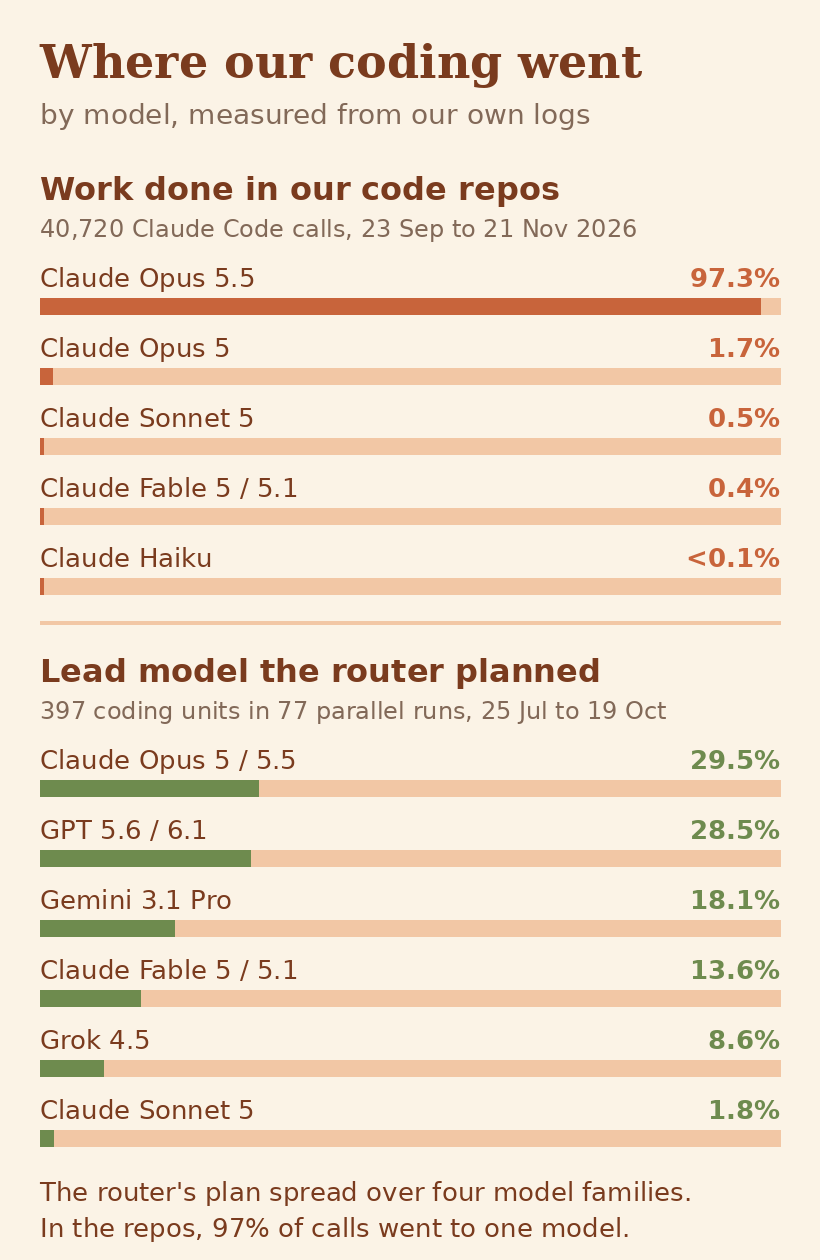
In the repos, almost everything went to one model. Of 40,720 Claude Code calls in our code projects between 23 September and 21 November, 97.3% ran on Claude Opus 5.5. The small models barely appear: Sonnet at 0.5%, Haiku under 0.1%. The bigger Fable model took 0.4%; we keep it for problems the default model gets stuck on.
The reason is money, just not the money you would expect. We run Claude Code on a flat subscription, so a cheaper model saves nothing until we hit the weekly limit. What does cost us is a wrong patch: our review time, a broken build, a rollback. On a flat plan, the strongest model is the cheap choice for almost every coding task. If you pay per token, the sums change; Claude Code pricing shows how much work each plan holds.
Outside the repos the picture flips. Over the same two months, 92% of our gateway’s model calls that did not go through Claude Code went to xAI’s Grok: scheduled checks and quick chat replies. A wrong answer there costs a retry, so a fast model is the right one. That is the same rule from the other side.
What a multi-model router taught us
For bigger jobs we tried to do better than one model. Our router sorted each coding unit by kind of work and picked a lead model from published benchmark leaders, then from our own results as they came in. Over 77 parallel runs between July and October it planned 397 units:
| Kind of work | Units | Most frequent lead model |
|---|---|---|
| Systems, builds, CI, shell | 158 | Claude Opus (72) |
| Math-heavy code | 83 | GPT (29) |
| Debugging | 65 | GPT (34) |
| New features | 28 | Claude Fable (12) |
| Algorithms | 24 | GPT (11) |
| Docs and specs | 14 | Claude Opus (9) |
| Research-heavy code | 13 | Gemini (7) |
| Large refactors | 12 | Claude Fable (9) |
When the scores for a kind of work were too close to call, it seated a panel of two to four models from different companies on the same question, and build units got a critic from another company to review the builder’s work. The idea is sound, because a model is a poor judge of its own blind spots, and a reviewer trained by another lab catches different mistakes.
Then we checked which model actually answered. Between 24 September and 3 October, the router asked for 104 seats on GPT, Gemini and Grok. The gateway’s call log for those ten days shows zero calls to Gemini and none to the Grok version we asked for, and the GPT seats named a model id that matched no provider. An audit of the transcripts traced those seats to the default Claude model: they had fallen back without an error. Our log of plans described a four-company panel; the work was one model talking to itself.
That is the most useful thing months of routing taught us, and it applies to any setup with more than one model: log the model that answered, not the model you asked for. A fallback is a feature until it hides a whole experiment. Without it, a comparison of “GPT vs Claude on debugging” from your own logs may be comparing Claude with Claude.
Pick the model by the size of the mistake you can afford
You would not hire a structural engineer to hang a picture, and you would not knock down a wall without one. Model choice works the same way. The job’s difficulty matters less than what happens if the result is wrong and nobody notices.
- Cheap to undo. Boilerplate, renames, test scaffolding, a commit message, summarizing a log, searching the codebase. A mistake costs one re-run, so use the fastest model you have; even a local one works, as long as you look at the result.
- Caught by your tests. A new endpoint, a bug fix with a failing test, a component. The tests catch the loud mistakes and your review catches the rest. Use the strongest model you can run on every change, because review time is your real bill. For us that is Claude Opus 5.5.
- Expensive or irreversible. A database migration, authentication, payments, deleting data, concurrency, infrastructure, a public API others build on. A mistake here can cost a weekend or a customer. Use the top model at high effort, ask for a plan before any edit, and have a model from another company review the diff before you merge, and then read it yourself.
Two more habits make the rule work. Escalate the model before the effort: when the default model goes in circles, a stronger model at normal effort usually beats the same model trying harder. And when a model fails twice on the same task, change the approach, not just the model. A task that stumps two frontier models is usually under-specified.
Best AI for coding, by budget
On a subscription, the rule above mostly lands on the top model, as our 97% shows. Paying per token, the tiers start to matter. On 22 November, llm-stats listed Claude Opus 5.5 at $4 per million input tokens and $20 per million output, and Sonnet 5.5 at half that. If most of your calls are in the “cheap to undo” tier, a smaller model there pays for the big one where it counts. If you can run a model at home, our post on buying hardware vs paying per token does the arithmetic, and VRAM swap covers fitting a big model on a desk.
FAQ
What is the best AI for coding right now?
The names at the top of the public leaderboards in November 2026 are Claude Fable 5.2, Claude Opus 5.5, GPT-6.2 Astra and Gemini 4 Neon, in a different order on each board and within a few points. In our own repos Claude Opus 5.5, run through Claude Code, did 97% of the work. Pick the strongest one you can afford to run on every change, and keep the biggest for the changes you cannot undo.
Is Claude or ChatGPT better for coding?
Both top houses are within a point or two on coding benchmarks. Our router’s benchmark-seeded table gave GPT the lead on debugging and math-heavy units and Claude on systems work, docs and large refactors, but our own outcome log could not separate them cleanly. Use the one whose agent you like working in, and use the other as the reviewer on risky changes.
Should I use one AI model or several for coding?
One strong default for almost everything, plus a second company’s model as a reviewer for expensive changes. More models only help if you can confirm which one answered each call; otherwise a fallback can turn your panel into one model without telling you.
Is Opus worth it over Sonnet for coding?
On a flat subscription, usually yes: it costs nothing extra until the weekly limit, and it saves review time. Paying per token, use Sonnet or a smaller model for the cheap-to-undo tier and keep Opus for changes your tests will not fully cover.
What is the best free AI for coding?
Free chat tiers and open-weight models you run yourself. Keep them on the cheap-to-undo tier: boilerplate, search, summaries. A free model on a database migration is not free if it costs you the database.
What we changed in TinkerClaw, and why
All of this is baked into TinkerClaw, our open-source build of OpenClaw. It records every model call with the provider and model that actually answered, so a fallback can’t hide, and its panels put the bill for each call next to it. Moving a chat to another model takes one dial, and the routing layer that picks a model per call ships with it, recording what it would choose before you let it decide. For a side-by-side of the two agents we run, see OpenClaw vs Claude Code.
We tinker with ideas like this all the time and bake them into the code the moment we get wind of a better way, or need one in our own day. Why that pace is possible at all is in from block to blob. The model router skill on ClawHub is the lighter version for a stock OpenClaw, and the live demo lets you click through it.
For builders
- THALAMUS (PDF): which model should answer each call, and how to learn it from your own outcomes; behind What a multi-model router taught us.
- Round Table (PDF): panels of models from different labs, and when their disagreement is worth paying for; behind the panel and critic seats in the same section.
- SEAHORSE: what makes an agent code well, beyond the model; behind Pick the model by the size of the mistake you can afford.
- There are others, by topic, in the brain map and the site map.
Leave a Reply